


You used to sleep fine. Now you’re wide awake at 3 a.m., the sheets are damp, you’ve kicked off the covers, and your mind is doing that thing where it refuses to switch off. Welcome to one of the most common — and least talked-about — parts of menopause.
If your sleep has fallen apart somewhere in your 40s or 50s, it’s almost certainly not random and it’s not your fault. Falling hormones change your sleep in real, physical ways. The good news: while you can’t stop the transition, a lot of what makes menopausal sleep so miserable is manageable. This guide explains what’s actually happening and walks through the steps that genuinely help.
This article contains affiliate links. If you buy through one, we may earn a commission at no extra cost to you. See our affiliate disclosure. It doesn’t change what we recommend.
Key Takeaways
- Sleep problems are one of the most common menopause symptoms — affecting a large share of women in perimenopause and beyond.
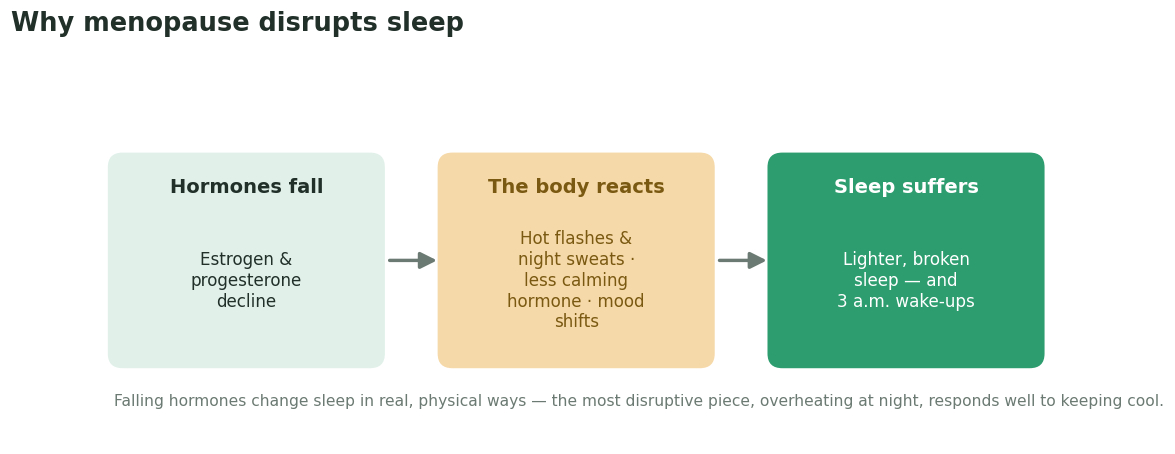
- Two hormones are the main culprits. Falling progesterone (a naturally calming, sleep-friendly hormone) and falling estrogen (which affects mood and temperature regulation) make sleep lighter and more broken.
- Hot flashes and night sweats are a major reason for those sudden 3 a.m. wake-ups.
- Keeping cool is the single most useful fix for sweat-driven waking — cooler room, breathable bedding, layers you can shed.
- It’s worth talking to a doctor. Persistent menopausal insomnia has real medical options (including hormone therapy) — that’s a conversation, not a supplement.
- Supplements are a minor lever. Habits, temperature, and stress management do far more for most women.
Is It Normal for Menopause to Wreck Your Sleep?
Unfortunately, yes — and you’re in large company. Difficulty sleeping is one of the hallmark complaints of perimenopause and menopause, and for many women it’s the symptom that affects daily life the most. Cleveland Clinic lists disrupted sleep right alongside hot flashes and mood changes as core features of the transition.
“Normal,” though, doesn’t mean “nothing you can do.” Because the causes are largely physical and behavioral, the same is true of many of the fixes.
Why Menopause Disrupts Your Sleep
There’s rarely one single reason. A few changes tend to pile up at once.
Progesterone drops — and progesterone is your calm hormone
Progesterone has a naturally calming, mildly sedative effect that supports restful sleep. As it declines through perimenopause, you lose some of that built-in “wind-down” signal — which is part of why falling and staying asleep gets harder, according to a narrative review of sleep and perimenopause.
Estrogen drops — affecting mood and your internal thermostat
Estrogen helps regulate serotonin (which influences both mood and sleep) and plays a role in the brain’s temperature-control center. As estrogen falls, two things happen: mood and anxiety can wobble, and your thermostat gets twitchy — setting the stage for hot flashes and night sweats.
Hot flashes and night sweats — the 3 a.m. ambush
This is the big one for a lot of women. A drop in estrogen disrupts the brain’s thermoregulation, so your body misreads its temperature and triggers a flash of heat. At night the pattern is brutal: you overheat, wake suddenly, throw off the covers, cool down — and then lie there unable to drift back off. According to the Sleep Foundation, these vasomotor symptoms are a leading cause of menopausal sleep disruption.
If this sounds exactly like our guide to why you wake up at 3 a.m., that’s no coincidence — menopausal women are one of the classic groups for early-morning waking, because the natural pre-dawn dip in temperature regulation collides with hormonal hot flashes.
Mood, anxiety, and a busy mind
Hormonal shifts can bring more anxiety, low mood, and racing thoughts — all of which make it harder to fall asleep and easier to wake. Add the stress of midlife (work, caregiving, everything else), and the mind has plenty to chew on at 3 a.m.
What Actually Helps
Keep cool — the highest-value fix
If hot flashes and night sweats are waking you, temperature is where to start:
- Drop the bedroom temperature. A cooler room (around the mid-60s °F / 18–19 °C) gives your body less to fight. See our guide to the ideal bedroom for sleep.
- Choose breathable bedding and sleepwear — cotton or moisture-wicking fabrics over synthetics.
- Layer so you can shed. A top sheet plus a light blanket beats one heavy duvet, so you can dump heat fast without fully waking.
- Keep a fan within reach, and a cool glass of water on the nightstand.

Protect the fundamentals
Hormones make good sleep habits matter more, not less:
- Keep a consistent schedule, even on weekends, to steady your body clock. Our complete guide to better sleep naturally covers the basics.
- Watch alcohol and caffeine — both can trigger or worsen hot flashes and fragment sleep. Our caffeine and sleep guide explains the timing.
- Build in a wind-down to quiet the mind before bed, and if you wake at night, use the gentle resets in our 3 a.m. guide (don’t clock-watch; get up if you’re wide awake).

Talk to a healthcare provider
This is the part a supplement can’t replace. Persistent menopausal insomnia has real medical options — including hormone therapy (estrogen, often with progesterone), which can ease hot flashes and improve sleep for many women, as well as non-hormonal prescription options. Whether any of these is right for you depends on your health history. It’s a conversation worth having rather than something to push through alone.
Do Supplements Help Menopausal Sleep?
Once the fundamentals and temperature are handled, some women look to supplements for a little extra help. Be realistic: these are a minor lever, the evidence is uneven, and none of them addresses the hormonal root cause. Use the figures below as reference information, not medical advice.
- Melatonin is a timing signal more than a sedative; it may help some women but won’t fix hot-flash-driven waking.
- Magnesium and herbal blends (valerian, chamomile, lavender) are popular and low-risk; the evidence is mixed, with modest benefits for some people.
- Multi-ingredient “wind-down” blends combine several of the above, sometimes with hemp compounds like CBD. If your problem is a racing, anxious mind, an ingredient that helps you relax may be more relevant than one that tries to sedate you. For the honest picture on the hemp side, see what the research says about CBD and sleep, plus our primer on CBN, the “sleepy cannabinoid”.
One option worth knowing: Cornbread Hemp organic sleep gummies
If you’d rather try a clean, plant-based wind-down than a synthetic sleep aid, Cornbread Hemp’s sleep gummies are one of the better-made options in this category — and a fit for the “organic, no-junk” preference a lot of women in this stage share.
Cornbread Hemp — USDA Organic Sleep Gummies
- What’s in them: USDA-certified organic, full-spectrum hemp plus a botanical sleep blend (valerian, chamomile, lavender) — and notably melatonin-free, so no next-day “melatonin hangover”
- Strengths: 25, 50, or 100 mg CBD per gummy (with ~1–4 mg THC, since it’s full-spectrum)
- Best for: winding down a busy, anxious mind before bed — not a treatment for hot flashes or menopause itself
- Honest expectation: some people find a hemp + herbal blend soothing; the evidence is early and mixed, and it works best alongside the temperature and habit fixes above
👉 See Cornbread Hemp Organic Sleep Gummies
Affiliate link — we may earn a commission, at no cost to you. See our affiliate disclosure.
A couple of honest caveats, because these are full-spectrum: they contain a small amount of THC (about 1–4 mg per gummy). That can, in some cases, show up on a drug test, and higher doses may feel mildly intoxicating — so start low, don’t take it before driving, and skip it entirely if you’re screened for THC. It isn’t appropriate alongside certain medications, so check with your healthcare provider first — especially during the menopause transition when you may be weighing other treatments.
When to See a Doctor
Talk to a healthcare provider if:
- Sleep problems are frequent and leaving you exhausted during the day.
- Hot flashes or night sweats are severe or disrupting your life.
- You have low mood, anxiety, or a racing heart that’s affecting daily functioning.
- You’d like to discuss hormone therapy or other medical options — these can make a real difference for the right person.
Menopausal insomnia is common, but it’s also genuinely treatable. You don’t have to white-knuckle through years of broken nights.
The Bottom Line
Menopause doesn’t have to mean surrendering your sleep. The wake-ups are driven by real hormonal change — falling progesterone and estrogen, and the hot flashes that follow — but the most disruptive piece, overheating at night, responds well to keeping cool. Layer that with steady habits, less alcohol and late caffeine, and a calm wind-down, and the nights tend to settle.
And if they don’t, the most evidence-based move isn’t another supplement — it’s a conversation with a provider about options like hormone therapy.
Frequently Asked Questions
Why do I wake up at 3 a.m. every night during menopause?
A natural pre-dawn dip in your body’s temperature regulation collides with menopausal hot flashes and a rising stress hormone (cortisol), making the early-morning hours the easiest time to wake — and the hardest to fall back asleep. Our 3 a.m. guide has the full picture.
Will menopause insomnia go away on its own?
For some women it eases after the transition settles; for others it lingers. You don’t have to wait it out — temperature management, sleep habits, and (if needed) medical options can help in the meantime.
Does CBD help with menopause sleep?
The honest answer is that the evidence is limited and mixed. Some women find a hemp or herbal blend helps them relax before bed, but it isn’t a proven treatment for menopause symptoms, and it won’t stop hot flashes. Think of it as one optional comfort tool, not a fix.
What’s the best room temperature for menopausal night sweats?
Cooler is better — many people aim for the mid-60s °F (around 18–19 °C), with breathable bedding and layers you can shed quickly.
Should I take melatonin for menopause sleep?
Melatonin helps with sleep timing more than staying asleep, so it’s of limited use against hot-flash-driven waking. It’s low-risk to try at a low dose, but don’t expect it to solve the problem.
Sources
- Cleveland Clinic — Perimenopause: Symptoms and Treatment
- Sleep Foundation — Menopause and Sleep
- Sleep Disturbance and Perimenopause: A Narrative Review (2024), PMC — Article
- NIH National Center for Complementary and Integrative Health — Melatonin: What You Need To Know
These statements have not been evaluated by the Food and Drug Administration. Hemp and CBD products are not intended to diagnose, treat, cure, or prevent any disease. This article is for informational purposes only and is not medical advice. Consult a qualified healthcare provider before starting any supplement or treatment, especially if you are pregnant, nursing, taking medications, or have a medical condition.