


You’ve probably seen it on a sleep gummy label: CBN, the “sleepy cannabinoid.” It’s the trendy ingredient that’s quietly taken over the nighttime shelf — promising deeper sleep without the grogginess of melatonin. But is there anything behind the marketing, or is “CBN for sleep” just a clever story?
The honest answer is somewhere in between. CBN is real, it’s interesting, and the early science is more promising than it was even a year ago — but it’s also been wildly oversold. This guide cuts through the hype: what CBN actually is, how it differs from CBD and melatonin, what the research really shows, and how to choose a product if you want to try it.
This article contains affiliate links. If you buy through one, we may earn a commission at no extra cost to you. See our affiliate disclosure. It doesn’t change what we recommend.
Key Takeaways
- CBN (cannabinol) is a minor hemp compound formed as the cannabis plant ages — it’s the breakdown product of THC, but on its own it is only very mildly psychoactive (and THC-free products contain none of the THC).
- The “sleepy cannabinoid” label is mostly marketing. For years it rested on anecdote and old, flawed studies — not solid human research.
- That’s starting to change. A 2024 University of Sydney study gave the first objective evidence that CBN increases sleep — but it was done in rats, and human trials are still underway.
- CBN is not melatonin. Melatonin shifts your sleep timing; CBN appears to work more on relaxation and sleep depth. They’re different tools.
- If you try it, the cleanest option is a THC-free, third-party-tested product from a transparent maker — so you know exactly what’s in it.
- No supplement beats the basics. CBN is a small lever; a cool room, a steady schedule, and less late caffeine matter far more.
What Is CBN, Exactly?
CBN stands for cannabinol. It’s one of the dozens of compounds (cannabinoids) found in the hemp and cannabis plant — but it’s a “minor” one, present in tiny amounts compared to CBD or THC.
Here’s the interesting part: CBN isn’t really made by the plant directly. It forms when THC ages and oxidizes — exposed to air, heat, and light over time, THC slowly converts into CBN. That’s why old, poorly stored cannabis was historically associated with drowsiness, and it’s where the “sleepy” reputation began.
A few things worth knowing:
- CBN is only very mildly intoxicating. It’s a degradation product of THC, but it does not produce anything like THC’s “high.”
- THC-free CBN products contain no THC at all. Broad-spectrum and isolate-based products have the THC removed, so there’s nothing psychoactive left.
- It’s legal at the federal level when derived from hemp containing less than 0.3% THC, though state laws vary.
CBN vs. CBD vs. Melatonin: What’s the Difference?
People lump these together, but they’re genuinely different tools for different problems. Here’s the simplest way to think about it.
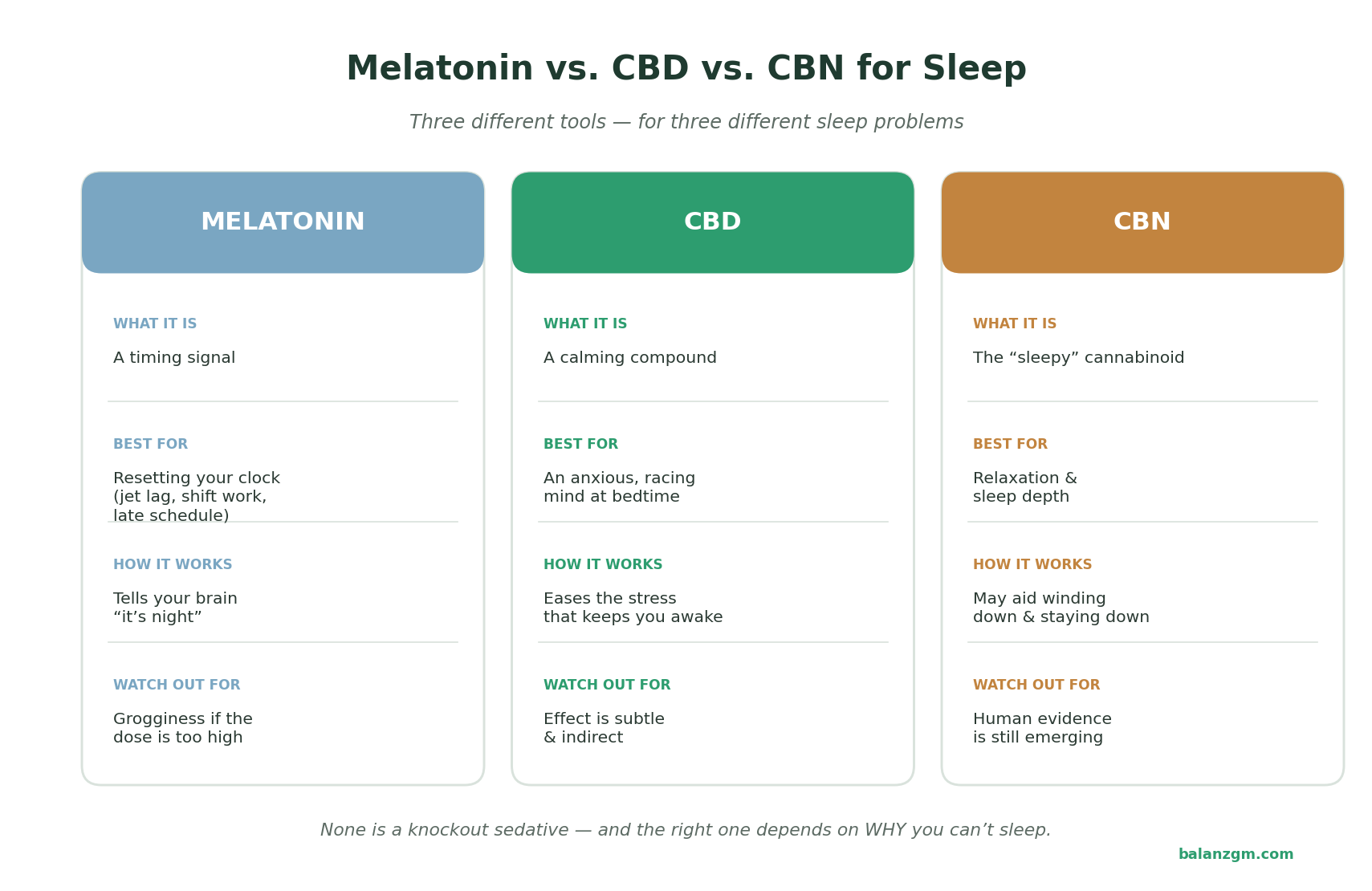
Melatonin is a timing signal, not a sedative. Your body makes it as it gets dark, and a supplement essentially tells your brain “it’s nighttime.” It’s most useful for shifting your clock — jet lag, shift work, a delayed sleep schedule — and less useful if your problem is staying asleep or a racing mind. Take too much and many people feel groggy the next morning.
CBD (cannabidiol) is the well-known hemp compound. It isn’t sedating in the classic sense; most of its sleep benefit seems to come indirectly — by easing the stress and anxiety that keep people awake. For the honest picture, see our deep dive on CBD and sleep.
CBN is the new arrival. The theory is that it acts more directly on relaxation and sleep depth than CBD does, and unlike melatonin it isn’t trying to reset your clock — it’s aimed at helping you wind down and stay down. In practice, most sleep products pair CBN with CBD (and sometimes herbs), betting that the combination works better than either alone.
The key takeaway: none of these is a knockout sedative, and the right one depends on why you can’t sleep.
Does CBN Actually Work for Sleep?
This is where you deserve a straight answer rather than a sales pitch.
For years, the evidence was thin. The “sleepy cannabinoid” reputation rested largely on anecdote, marketing, and a handful of small, old studies — some of which actually suggested CBN alone did very little. If you read the careful reviews, the honest summary was: promising idea, not much proof.
That picture is now improving. In late 2024, researchers at the University of Sydney published the first objective evidence that CBN increases sleep. Using brain-activity recordings in rats, they found CBN increased total sleep time — boosting both non-REM and REM sleep — with an effect the researchers compared to a common prescription sleep drug. They also identified an active byproduct, 11-OH-CBN, that may do much of the work. (University of Sydney)
But read the fine print:
- It was done in animals, not people. Rat sleep is a useful model, but it’s not proof that a gummy will work for you.
- Human trials are still in progress. A dedicated clinical trial in people with insomnia (the “CUPID” study) is underway to test exactly this. (study protocol)
- The results were nuanced — for example, CBN shifted when different sleep stages happened, and researchers flagged that more work is needed on long-term effects.
So where does that leave you? CBN is a genuinely interesting compound with the best early evidence it’s ever had — but “first objective evidence in rats” is a long way from “clinically proven sleep aid.” Approach CBN as a reasonable thing to try, with realistic expectations, not a guaranteed fix. Many people find a CBN + CBD blend pleasantly relaxing before bed; some notice nothing. Both are normal.
How to Use CBN for Sleep
If you decide to experiment, a few sensible ground rules:
- Start low. A small dose (often half a serving) about 30–60 minutes before bed is the usual starting point. You can build up if needed.
- Be consistent. Cannabinoids seem to work best as part of a steady nightly routine rather than a one-off rescue.
- Give it a couple of weeks. Judge it over 1–2 weeks of consistent use, not a single night.
- Don’t stack it with alcohol or other sedatives, and don’t drive after taking it.
- Talk to your doctor first if you take any medications — cannabinoids can interact with some of them.

What to Look For in a CBN Product
The CBN market is full of vague labels and inflated claims, so the quality bar matters more here than almost anywhere. Look for:
- A clear cannabinoid breakdown — exactly how many milligrams of CBN and CBD per serving. (Vague “sleep blend” totals are a red flag.)
- Third-party lab tests (a COA) you can actually find and read, confirming potency and purity.
- THC-free, if you want zero risk of psychoactive effects — broad-spectrum or isolate-based products have the THC removed.
- A transparent, US-based maker with real manufacturing standards (like a cGMP-certified facility), not an anonymous white-label brand.
- A money-back guarantee, since cannabinoids are individual — what helps one person may do nothing for another.
One clean option: Extract Labs THC-Free CBN + CBD Sleep Gummies
If you want to try CBN without the THC question hanging over it, Extract Labs’ THC-Free CBN + CBD Sleep Gummies are one of the more transparent options on the market — and a good example of what “done right” looks like in this category.
Extract Labs — THC-Free CBN + CBD Sleep Gummies
- Clean, clear dosing: a precise 3:1 ratio of 30 mg CBD + 10 mg CBN per gummy — no vague “blend” math
- THC-free (broad spectrum): the THC is removed, so there’s no high — though, like any hemp product, the brand can’t guarantee drug-test results
- Melatonin-free: aimed at relaxation and sleep depth, not at resetting your clock — so no “melatonin hangover”
- Made transparently: US-grown hemp, made in a cGMP-certified facility, vegan, with public third-party lab results and a 60-day money-back guarantee
- Best for: people who want to try the “sleepy cannabinoid” cleanly — not a cure for insomnia or any medical condition
👉 See Extract Labs THC-Free CBN + CBD Sleep Gummies
Affiliate link — we may earn a commission, at no cost to you. See our affiliate disclosure.
One honest note: because CBN products are derived from hemp, the maker can’t promise a clean drug test even on a THC-free product. If you’re tested for any reason, the safest choice is to skip cannabinoids entirely.
CBN Won’t Fix the Basics
Here’s the part the gummy ads leave out: no cannabinoid can out-muscle bad sleep conditions. If you’re going to spend money on CBN, make sure the free stuff is handled first — it does far more:

- Keep your bedroom cool and dark. See our guide to the ideal bedroom for sleep.
- Hold a consistent schedule, even on weekends — the single most powerful sleep habit. Our guide to better sleep naturally walks through the rest.
- Watch late caffeine, which lingers for hours; our caffeine and sleep guide explains the timing.
- If you keep snapping awake in the early hours, the cause often isn’t a missing supplement — read why you wake up at 3 a.m. Women navigating menopause and sleep are an especially common case.
Think of CBN as the last 5% you add once everything else is in place — not the first thing you reach for.
When to See a Doctor
A sleep gummy isn’t the answer if:
- Your insomnia is frequent and wrecking your days.
- You snore heavily, gasp, or stop breathing in your sleep (possible sleep apnea).
- Sleeplessness comes with anxiety, low mood, or a racing heart that affects daily life.
- You take medications that could interact with cannabinoids.
Persistent insomnia is common and treatable — a doctor has far more effective tools than any supplement.
The Bottom Line
CBN is more than pure hype, but a lot less than the labels imply. It’s a minor hemp compound with a long-standing “sleepy” reputation that, until recently, rested mostly on marketing — and now has its first solid (animal) evidence behind it, with human trials still to come. It works differently from melatonin and CBD, and many people find a CBN + CBD blend genuinely relaxing before bed.
If you want to try it, choose a clean, THC-free, lab-tested product and set realistic expectations — and build it on top of good sleep habits, not in place of them. And if your sleep problems are serious or persistent, that’s a conversation for a doctor, not a gummy.
Frequently Asked Questions
Is CBN the same as CBD?
No. Both are hemp compounds, but CBD is the well-known one usually associated with easing stress, while CBN is a minor compound (a breakdown product of THC) marketed for sleep. Most sleep products combine the two.
Will CBN get me high?
On its own, CBN is only very mildly psychoactive, and THC-free CBN products contain no THC — so they shouldn’t cause a high. They still aren’t guaranteed to pass a drug test, however.
Is CBN better than melatonin for sleep?
It’s not “better” — it’s different. Melatonin shifts your sleep timing and is best for jet lag or a delayed schedule. CBN is aimed more at relaxation and sleep depth. Some people prefer CBN specifically because it avoids the next-day grogginess melatonin can cause.
How much CBN should I take for sleep?
Start low — often around 10 mg of CBN (or half a serving) — about 30–60 minutes before bed, and adjust gradually over a week or two. Talk to your doctor if you take other medications.
Does CBN actually work, or is it a scam?
It’s not a scam, but it’s been oversold. The early evidence is promising — including a 2024 study showing CBN increased sleep in rats — but human proof is still limited. Try it with realistic expectations.
Sources
- University of Sydney — “Sleepy cannabis: first objective study to show cannabinol increases sleep” (2024)
- Neuropsychopharmacology — “A sleepy cannabis constituent: cannabinol and its active metabolite influence sleep architecture in rats” (2024)
- PMC — Cannabinol (CBN) effects on sleep in insomnia disorder (“CUPID” study): protocol (2023)
- NIH NCCIH — Melatonin: What You Need To Know
These statements have not been evaluated by the Food and Drug Administration. Hemp, CBD, and CBN products are not intended to diagnose, treat, cure, or prevent any disease. This article is for informational purposes only and is not medical advice. Consult a qualified healthcare provider before starting any supplement, especially if you are pregnant, nursing, taking medications, or have a medical condition.