

You were asleep just fine. Then, seemingly out of nowhere, your eyes open. The room is dark, the house is quiet, and the clock reads 3:07. You weren’t planning to be awake — and now that you are, your mind is already starting to spin.
If this happens to you several nights a week, you’re in very common company. Waking in the small hours is one of the most frequent sleep complaints there is. The good news: in most cases it’s not a sign that something is broken. This guide explains why the early-morning hours are when we’re most likely to surface — and, more usefully, what actually helps you drift back off instead of lying there watching the minutes crawl by.
The Short Answer
Brief awakenings in the night are completely normal — everyone has them, most people just don’t remember them. The reason 3 AM feels like your time is that the second half of the night is when your sleep is naturally lightest, your stress hormones are starting to climb, and small disturbances are most likely to tip you all the way awake — one reason menopausal women are especially prone to early-morning waking.
The problem usually isn’t the waking. It’s the not falling back asleep — and that part you have real influence over.
Key Takeaways
- Waking briefly at night is normal. By the early-morning hours, most of your deep sleep is behind you and you’re in lighter, dream-heavy sleep that’s easy to surface from.
- Cortisol naturally rises toward morning, and stress or anxiety can amplify that rise into a full wake-up.
- Common culprits include alcohol, a full bladder, a racing mind, and simply getting older — most of which are fixable.
- The fastest way back to sleep is often to stop trying so hard — don’t check the clock, and get out of bed if you’re still wide awake after about 20 minutes.
- Supplements are a minor lever, not a fix. Habits and timing do far more for most people.
- See a doctor if waking is frequent, you snore or gasp, or you’re exhausted during the day — it could point to something treatable like sleep apnea.
Is Waking Up at 3 AM Actually Normal?
Yes — and more than most people realize. Healthy sleepers wake briefly many times a night during the natural transitions between sleep stages. Usually these awakenings are so short you have no memory of them by morning.
What makes a 3 AM waking feel like a problem is when you become fully conscious, notice the time, and then can’t switch back off. That experience is real and frustrating, but it doesn’t mean your sleep is fundamentally damaged. It usually means a normal, brief arousal collided with something — a noise, a full bladder, a stressful thought — and your brain decided to stay online.
Why 3 AM Specifically?
There’s rarely a single cause. More often, a few of the following stack up at the same hour.
Most of your deep sleep is already behind you
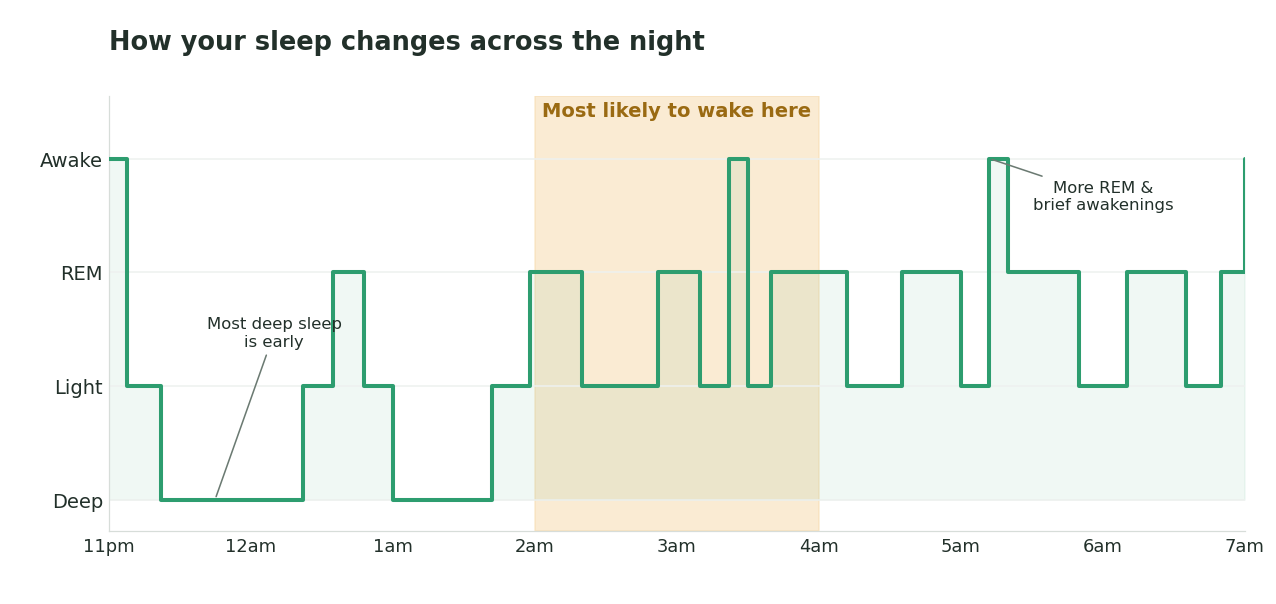
Over the course of the night, you move through several sleep cycles of roughly 90 minutes each. But the cycles aren’t identical. Your deepest, most restorative sleep is front-loaded into the first half of the night, while the second half holds progressively more light sleep and REM (the dream stage), according to the Sleep Foundation.
That matters because light and REM sleep are simply easier to wake from than deep sleep. So by 2–4 AM — a few cycles in — you’re spending more time in the stages where a minor disturbance can pull you all the way up. (If you want the full picture of how cycles work, see our guide to how much sleep you really need and how sleep cycles work.)
Your cortisol is starting to climb
Cortisol often gets cast as the villain “stress hormone,” but it’s also part of your normal wake-up machinery. Levels naturally begin rising in the pre-dawn hours as your body prepares to start the day — that gentle climb is supposed to happen.
The trouble comes when you’re already running hot. If you’re stressed, anxious, or stretched thin, baseline cortisol tends to sit higher, so the early-morning rise can push you from light sleep into full wakefulness rather than easing you toward morning. It’s one reason stressful seasons of life so often come with 3 AM wake-ups.
A busy mind turns a blip into a wake-up
This is the big one. A brief, harmless arousal becomes a 90-minute ordeal the moment your brain latches onto a worry — tomorrow’s to-do list, a difficult conversation, money, the fact that you’re awake again.
It’s made worse by a small, sneaky habit: checking the clock. Seeing “3:14” instantly does the math (“I have to be up in three hours”) and triggers a jolt of stress — which is exactly the wrong chemistry for falling back asleep. The clock turns a quiet moment into a countdown.

Alcohol — the nightcap trap
A drink before bed can help you fall asleep faster, which is why it feels relaxing. But that’s a short-lived trade. As your body metabolizes the alcohol in the second half of the night, you get a rebound effect — sleep becomes lighter and more fragmented, with more frequent awakenings, the Sleep Foundation explains. If your 3 AM wake-ups cluster on the nights you’ve had a couple of drinks, that’s not a coincidence.
A full bladder
Sometimes the answer is the simplest one. Waking to use the bathroom — known as nocturia — is a leading cause of disrupted nights. Cleveland Clinic notes that fluids close to bedtime, alcohol and caffeine (both bladder irritants), and conditions like sleep apnea, diabetes, or an enlarged prostate can all drive nighttime urination. If you’re waking specifically because you need to go, that’s a useful clue, not just an annoyance.
You’re getting older
Sleep changes with age, and not because you need less of it. As we get older, we spend more time in lighter stages and less in deep sleep, and our nights become more fragmented, according to the Sleep Foundation. The body also produces less melatonin over time. The net effect: small disturbances that you’d have slept through at 25 are more likely to wake you at 55.
What about blood sugar?
You’ll often see 3 AM waking blamed on a blood-sugar dip. For most healthy adults, the evidence here is limited, and it’s not the first place to look. It’s more relevant if you have diabetes or another blood-sugar condition, or if a very large, late, or alcohol-heavy meal is part of your evening — in which case it’s worth raising with your doctor rather than self-diagnosing.
3 AM waking at a glance
| Why you might be waking | What tends to help |
|---|---|
| Lighter sleep in the second half of the night | It’s normal — focus on falling back asleep, not on preventing the waking |
| A racing or anxious mind | Don’t clock-watch; get out of bed after ~20 minutes; deal with stress during the day |
| Alcohol in the evening | Drink earlier or less, and watch what happens to your wake-ups |
| Caffeine too late in the day | Move your cut-off earlier (see our caffeine-and-sleep guide) |
| A full bladder | Limit fluids before bed; reduce evening alcohol and caffeine |
| Age-related lighter sleep | Tighten the fundamentals; keep the room cool, dark, and quiet |
| Snoring or gasping, or waking most nights | See a healthcare provider to rule out a treatable cause |
How to Fall Back Asleep at 3 AM
When you’re lying there at 3 AM, the goal isn’t to force sleep — that backfires. It’s to remove the friction so sleep can return on its own.
Don’t look at the clock. Turn it away, or put your phone across the room. Knowing the exact time does nothing for you and almost always adds stress. This one change helps more people than they expect.
Use the 20-minute rule. If you’ve been awake and frustrated for roughly 20 minutes, don’t keep lying there. Get up, go to another dimly lit room, and do something calm and boring — read a few pages of a dull book, sit quietly — until you feel sleepy, then go back to bed. This comes from stimulus control, a core part of the gold-standard insomnia treatment (CBT-I) endorsed by the American Academy of Sleep Medicine. The point is to keep your bed associated with sleep, not with tossing and worrying.
Keep it dark and screen-free. Bright light — especially from a phone — tells your brain it’s morning. If you get up, keep the lights low and skip the scrolling.
Calm your body down. Slow breathing genuinely helps shift you out of “alert” mode. A simple approach: breathe in for a count of four, out for a count of six, and let the exhale be longer than the inhale. You’re not trying to fall asleep on command — just lowering the arousal that’s keeping you up.
How to Stop Waking Up at 3 AM in the First Place
In-the-moment tricks help, but the real wins come from what you do during the day and evening.
Keep a consistent schedule. Going to bed and waking at roughly the same times — yes, even on weekends — is one of the most powerful things you can do for stable, unbroken sleep. An erratic schedule keeps your body clock guessing.
Rethink the nightcap. If you drink, try moving it earlier in the evening or cutting back, and watch what happens to your 3 AM wake-ups. Many people are surprised how much of their fragmented sleep traces back to that last drink.
Mind your caffeine timing. Caffeine lingers far longer than most people think, and an afternoon coffee can still be quietly undermining your sleep at 3 AM. Our guide to caffeine and sleep breaks down how late is too late.
Set up your bedroom for sleep. A room that’s cool, dark, and quiet gives you fewer reasons to surface. See our breakdown of the ideal bedroom for sleep for the specifics on temperature, light, and noise.
Deal with daytime stress — during the day. Since stress is such a common driver of early-morning waking, the fix often happens before bed: a wind-down routine, jotting tomorrow’s worries onto paper so your brain can let them go, or simply protecting a buffer between work and sleep.
Nail the fundamentals. Most chronic night-waking improves when the basics are solid. Start with our complete guide to better sleep naturally, the common sleep hygiene mistakes worth avoiding, and our practical steps for how to fall asleep faster.

Do Supplements Help You Stay Asleep?
Once the habits are in place, some people look to supplements for a little extra help. It’s worth being realistic: these are a minor lever, not a solution, and the evidence is uneven. Use the figures below as reference information, not medical advice.
- Melatonin is widely misunderstood. It’s a timing signal, not a sedative — most useful for jet lag or a shifted body clock, and less so for staying asleep, per the NIH’s National Center for Complementary and Integrative Health. When people do use it, low doses (around 0.5–1 mg) and correct timing matter more than big doses.
- Magnesium, glycine, L-theanine, and valerian show up in most sleep blends. The research is mixed: some small studies suggest modest benefits — L-theanine for stress, glycine for sleep quality — while valerian’s results are inconsistent, according to the Sleep Foundation. None is a reliable knockout.
- Multi-ingredient “wind-down” blends combine several of the above, sometimes with hemp compounds like CBD (see our guide to CBN, the “sleepy cannabinoid”). If the thing keeping you up is a racing mind rather than a timing problem, an ingredient that helps you relax may be more relevant than one that tries to sedate you. For an honest look at the hemp side specifically, see what the research actually says about CBD and sleep and our overview of the best CBD for sleep.
When to See a Doctor
Most 3 AM waking is benign. But some patterns deserve a professional’s attention rather than a supplement:
- Night-waking that happens most nights for more than a few weeks, or that leaves you exhausted during the day.
- Snoring, gasping, or choking in your sleep, or being told you stop breathing — possible signs of sleep apnea.
- Waking to urinate multiple times a night, which can point to an underlying condition.
- Waking with anxiety, low mood, or a racing heart that’s affecting your daily life.
A healthcare provider can rule out treatable causes that no amount of sleep hygiene will fix on its own.
The Bottom Line
Waking at 3 AM usually isn’t a malfunction — it’s your body doing roughly what it’s designed to do, at the hour when sleep is naturally lightest and stress chemistry is on the rise. The lever you actually control is what happens next: don’t reach for the clock, don’t fight it in bed, and put the daytime and evening fundamentals in place so the wake-ups get rarer and shorter.
If they don’t — if 3 AM keeps winning night after night — that’s the moment to talk to a healthcare provider rather than reaching for one more supplement.
Frequently Asked Questions
Why do I wake up at exactly 3 AM every night?
It’s rarely magic about that precise minute. If you fall asleep around the same time each night, you’ll hit your lighter, wake-prone sleep stages at roughly the same time too — which tends to land in the small hours. Layer on the natural pre-dawn cortisol rise and a consistent trigger (a full bladder, a worry, a partner stirring), and the same clock reading shows up night after night.
Is waking up at 3 AM a sign of anxiety?
It can be. Stress and anxiety raise your baseline arousal and stress hormones, making it easier to wake during light sleep and harder to fall back asleep once your mind starts running. It’s one of the most common drivers — but it’s far from the only one, so it’s not proof of an anxiety disorder on its own.
Should I eat something if I wake up at 3 AM?
Usually no. Eating can actually signal your body to wake up more, and for most people a 3 AM snack isn’t necessary. The exception is if you have a blood-sugar condition and your doctor has advised it.
How do I fall back asleep fast?
Don’t check the clock, keep the lights off, and slow your breathing. If you’re still wide awake after about 20 minutes, get out of bed, do something calm and boring in dim light, and return when you feel sleepy. Trying to force sleep tends to keep you awake longer.
Is it bad to wake up at 3 AM every night?
A brief waking you fall back asleep from isn’t harmful. It becomes worth addressing when it’s frequent, leaves you tired during the day, or comes with symptoms like snoring or gasping — in which case it’s worth seeing a doctor.
Sources
- Sleep Foundation — REM Sleep: What It Is and Why It’s Important
- Sleep Foundation — Alcohol and Sleep
- Sleep Foundation — Aging and Sleep
- Sleep Foundation — Natural Sleep Aids: Which Are the Most Effective?
- American Academy of Sleep Medicine — Cognitive Behavioral Therapy for Insomnia (CBT-I)
- Cleveland Clinic — Nocturia (Waking to Urinate at Night)
- NIH National Center for Complementary and Integrative Health — Melatonin: What You Need To Know
These statements have not been evaluated by the Food and Drug Administration. Hemp and CBD products are not intended to diagnose, treat, cure, or prevent any disease. This article is for informational purposes only and is not medical advice. Consult a qualified healthcare provider before starting any supplement, especially if you are pregnant, nursing, taking medications, or have a medical condition.