

Weight loss › How GLP-1 medications work
BalanzGM is reader-supported — we may earn a commission from links on this site, at no extra cost to you. See our affiliate disclosure. This article is information, not medical advice.
The short version. GLP-1 is a hormone your gut releases when you eat. It tells the pancreas to release insulin, tells the liver to hold back glucagon, slows how fast the stomach empties, and signals fullness. Semaglutide and tirzepatide are engineered to imitate that signal and to last far longer than the natural version. Everything else about these drugs — the weekly injection, the slow dose ramp, the nausea, the low hypoglycaemia risk — follows from those few facts.
What GLP-1 is
Glucagon-like peptide-1 is an incretin hormone. Your small intestine makes it and releases it in response to food. Harvard Health describes it as a hormone that “is released by the gut in response to eating and has several effects that help regulate blood sugar levels, hunger, and slow digestion.”
Cleveland Clinic lists the four things it does: triggering insulin release from the pancreas, blocking glucagon secretion, slowing stomach emptying, and increasing how full you feel after eating. Those four mechanisms are the whole story, and each one maps onto something you would notice while taking the medication.
The detail that explains the safety profile
Natural GLP-1 works in a glucose-dependent way. Harvard Health puts it directly: GLP-1 drugs “lower blood sugar only when it’s high, unlike insulin, which works regardless of glucose levels.”
This is why hypoglycaemia is not a headline risk when a GLP-1 is used on its own. It becomes one when the drug is combined with insulin or a sulfonylurea, and the FDA labels say so explicitly — the Wegovy label warns that “risk of hypoglycemia is increased when WEGOVY is used concomitantly with insulin or insulin secretagogues.” If you take either, that is a conversation to have before you start, not after.
What the drugs do differently from the hormone
Native GLP-1 breaks down within minutes. A drug that lasted minutes would be useless. The engineering problem was protraction — making the molecule survive.
The FDA-approved prescribing information for Wegovy describes semaglutide as “a GLP-1 analogue with 94% sequence homology to human GLP-1” that “acts as a GLP-1 receptor agonist that selectively binds to and activates the GLP-1 receptor, the target for native GLP-1.” The Ozempic label explains how it lasts: “The principal mechanism of protraction resulting in the long half-life of semaglutide is albumin binding, which results in decreased renal clearance and protection from metabolic degradation.”
In plain terms: the molecule hitches a ride on a blood protein, which keeps the kidneys from clearing it and enzymes from chewing it up. That is what turns a minutes-long hormone into a once-weekly injection.
Tirzepatide adds a second receptor
Tirzepatide is not a longer semaglutide. It hits a different set of targets. The Zepbound label states that tirzepatide “is a GIP receptor and GLP-1 receptor agonist” that “selectively binds to and activates both the GIP and GLP-1 receptors.”
GIP — glucose-dependent insulinotropic polypeptide — is the other major incretin hormone. What the extra receptor contributes is genuinely not settled, and the label is careful about it: “Nonclinical studies suggest the addition of GIP may further contribute to the regulation of food intake.” Nonclinical. Suggest. May. If you read a page telling you confidently that dual agonism is why tirzepatide performs the way it does, that page has gone further than the FDA label does.
We cover the practical differences in semaglutide vs tirzepatide.
Why the dose starts low and climbs slowly
Nobody starts at a maintenance dose. Wegovy’s label instructs clinicians to “initiate at 0.25 mg once weekly for 4 weeks” and then titrate every four weeks — 0.25, 0.5, 1, 1.7, and then a usual maintenance dose of 2.4 mg once weekly. Zepbound starts at 2.5 mg weekly for four weeks, moves to 5 mg, and can rise in 2.5 mg increments no faster than every four weeks, to a maximum of 15 mg.
That schedule exists because of the gastrointestinal effects. The slowed stomach emptying that helps you feel full is the same mechanism that produces nausea, and the body adapts to it gradually. Escalating faster does not get you there sooner; it mostly gets you nausea.
Why appetite changes rather than willpower
The Wegovy label contains one sentence that reframes the whole category: “GLP-1 is a physiological regulator of appetite and caloric intake.”
Mayo Clinic describes the practical effect: these medications “appear to curb hunger” and “slow the movement of food from the stomach into the small intestine” so that patients “feel full faster and longer, so you eat less.”
Appetite regulation is a physiological system, and these drugs act on it directly. That is also why the labels pair the medication with diet and activity rather than replacing them — the Zepbound indication reads “in combination with a reduced-calorie diet and increased physical activity.”
What this does not tell you
Understanding the mechanism does not tell you whether treatment is appropriate for you. That depends on the boxed warning, the contraindications, and your own history — see who qualifies and side effects by the numbers.
It also does not tell you what you are actually being sold. Mechanism is a property of the molecule; what arrives at your door depends on whether the product is FDA-approved or compounded, and those are not the same thing. See compounded vs brand-name.
Sources
- FDA prescribing information, WEGOVY (semaglutide) injection and tablets, rev. 05/2026 — accessdata.fda.gov
- FDA prescribing information, ZEPBOUND (tirzepatide) injection, rev. 01/2026 — accessdata.fda.gov
- FDA prescribing information, OZEMPIC (semaglutide) injection, rev. 01/2025 — accessdata.fda.gov
- Cleveland Clinic, “GLP-1 Agonists”, last updated 3 July 2023 — my.clevelandclinic.org
- Harvard Health Publishing, “How does Ozempic work?”, 14 April 2025 — health.harvard.edu
- Mayo Clinic, “Diabetes drugs and weight loss”, last updated 14 November 2024 — mayoclinic.org
More in the weight loss hub: semaglutide vs tirzepatide · who qualifies
Compounded medications are not FDA-approved and are not generic versions of brand-name drugs. Eligibility and treatment are determined by a US-licensed clinician; results vary.
Medical disclaimer. This article is for general information only and is not medical advice. It is not intended to diagnose, treat, cure or prevent any condition. Prescription treatments require evaluation by a US-licensed clinician, who decides whether treatment is appropriate for you. Talk to your own healthcare provider before starting, stopping or changing any medication. Individual results vary.
Related review
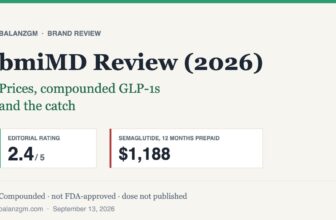
bmiMD review — a telehealth brand selling these drugs compounded from $99 a month, without publishing a single milligram figure.