

Weight loss › Semaglutide vs tirzepatide
BalanzGM is reader-supported — we may earn a commission from links on this site, at no extra cost to you. See our affiliate disclosure. This article is information, not medical advice.
The short version. Semaglutide activates one receptor; tirzepatide activates two. They sit in different products with different approved uses, different dose ladders and, in one case, a pill option. There is one head-to-head trial, and its result only means something if you carry the doses along with it — which most coverage does not. This page is a comparison of what the two molecules are, drawn from the FDA labels.
Different targets
Semaglutide is a GLP-1 receptor agonist. It binds one receptor — the target of natural GLP-1. The Wegovy label describes it as “a GLP-1 analogue with 94% sequence homology to human GLP-1.”
Tirzepatide binds two. The Zepbound label states it “selectively binds to and activates both the GIP and GLP-1 receptors, the targets for native GIP and GLP-1.”
What the second receptor contributes is not established. The same label says only that “nonclinical studies suggest the addition of GIP may further contribute to the regulation of food intake.” That hedge is the FDA’s, and it is worth keeping. Any page that tells you dual agonism is the reason for a difference in results is asserting something the regulator declines to assert.
Different products — and this is where people get lost
Both molecules appear in more than one product, and the products are not interchangeable. Only two of the six below are approved for weight reduction.
| Product | Molecule | Form | Approved for weight loss? |
|---|---|---|---|
| Wegovy injection | Semaglutide | Weekly injection | Yes — plus cardiovascular risk reduction and, in adults, MASH with F2–F3 fibrosis |
| Wegovy tablets | Semaglutide | Daily tablet | Yes, adults only — approved 22 December 2025 |
| Ozempic | Semaglutide | Weekly injection | No — type 2 diabetes, CV risk and CKD indications |
| Rybelsus | Semaglutide | Daily tablet | No — type 2 diabetes and CV risk |
| Zepbound | Tirzepatide | Weekly injection | Yes — plus moderate-to-severe obstructive sleep apnoea in adults with obesity |
| Mounjaro | Tirzepatide | Weekly injection | No — type 2 diabetes, adults and children 10+ |
Different dose ladders
Both drugs are titrated slowly, and neither lets you skip steps.
Semaglutide, Wegovy injection
The label instructs: “Initiate at 0.25 mg once weekly for 4 weeks”, then titrate every four weeks — 0.5 mg, 1 mg, 1.7 mg — to a usual maintenance dose of “2.4 mg once weekly.” Since the 05/2026 revision the label also allows a higher maximum: after tolerating 2.4 mg for at least four weeks, “the dosage may be increased to a maximum dosage of 7.2 mg.” That higher strength, Wegovy HD, was approved on 19 March 2026.
Semaglutide, Wegovy tablets
A different ladder entirely: 1.5 mg daily for 30 days, then 4 mg, then 9 mg, then 25 mg maintenance from day 91. Administration is fussier than an injection — “take one WEGOVY tablet orally once daily on an empty stomach in the morning with water (up to 4 ounces).”
The label’s own comparison is worth quoting precisely, because the qualifier travels with it: semaglutide concentrations on the 25 mg daily tablet “are predicted to be comparable to WEGOVY 2.4 mg once-weekly injection” — but in patients with type 2 diabetes, tablet concentrations are lower and more variable. “The pill equals the shot” is not quite what the label says.
Tirzepatide, Zepbound
“The recommended starting dosage of ZEPBOUND for all indications is 2.5 mg injected subcutaneously once weekly for 4 weeks… After 4 weeks, increase the dosage to 5 mg.” After that, increases of 2.5 mg no more often than every four weeks. Maintenance for weight reduction is 5, 10 or 15 mg weekly; the maximum is 15 mg. There is no oral tirzepatide.
The head-to-head trial, with the doses attached
One randomised trial has compared them directly for obesity: SURMOUNT-5, published in the New England Journal of Medicine in 2025.
751 adults with obesity were randomised for 72 weeks to tirzepatide at a maximum tolerated dose of 10 mg or 15 mg weekly versus semaglutide at a maximum tolerated dose of 1.7 mg or 2.4 mg weekly. Least-squares mean change in body weight was −20.2% with tirzepatide and −13.7% with semaglutide. Waist circumference fell 18.4 cm versus 13.0 cm. The most common adverse events in both arms were gastrointestinal, mostly mild to moderate and concentrated during dose escalation.
1. The semaglutide arm was capped at 2.4 mg. Wegovy HD at 7.2 mg was approved in March 2026, after this trial, and was not tested in it.
2. “Maximum tolerated dose” means not every participant reached the top of either ladder. The comparison is between two titration strategies, not between two fixed doses.
A percentage quoted without those two facts is not a finding, it is a marketing line.
It is also worth saying what a trial average is not. It is not a forecast for one person. Trial populations are screened, supported and monitored in ways that ordinary care is not.
Side-effect profiles are not comparable across labels
Both drugs produce mainly gastrointestinal effects, and both labels publish frequency tables. Those tables come from different trials with different populations and different placebo rates — the placebo nausea rate is 16% in the Wegovy table and 8% in the Zepbound table. Setting the two columns side by side looks informative and is not. We give each drug’s figures separately in side effects, by the numbers.
One difference is genuinely specific to tirzepatide and is under-reported: the Zepbound label advises females using oral contraceptives “to switch to a non-oral contraceptive method or add a barrier method of contraception for 4 weeks after initiation and for 4 weeks after each dose escalation.” There is no equivalent instruction on the semaglutide labels.
So which one
That is not a question a website can answer, and we are not going to pretend otherwise. It depends on your indication, your history, what your clinician judges appropriate, what is actually available to you and what you can sustain. What this page can do is make sure you are comparing the right things: two molecules, six products, two dose ladders, and one trial whose headline number only means something with its doses attached.
Sources
- FDA prescribing information, WEGOVY injection and tablets, rev. 05/2026 — accessdata.fda.gov
- FDA prescribing information, ZEPBOUND, rev. 01/2026 — accessdata.fda.gov
- FDA prescribing information, MOUNJARO, rev. 01/2026 — accessdata.fda.gov
- FDA prescribing information, OZEMPIC, rev. 01/2025 — accessdata.fda.gov
- FDA prescribing information, RYBELSUS, rev. 10/2025 — accessdata.fda.gov
- FDA approval letter, NDA 218316, Wegovy tablets, 22 December 2025 — accessdata.fda.gov
- FDA press announcement, higher-dose semaglutide approval, 19 March 2026 — fda.gov
- Aronne LJ, Horn DB, le Roux CW, et al. “Tirzepatide as Compared with Semaglutide for the Treatment of Obesity.” N Engl J Med 2025;393(1):26–36. PMID 40353578 — pubmed.ncbi.nlm.nih.gov
More in the weight loss hub: how GLP-1 medications work · compounded vs brand-name
Compounded medications are not FDA-approved and are not generic versions of brand-name drugs. Eligibility and treatment are determined by a US-licensed clinician; results vary.
Medical disclaimer. This article is for general information only and is not medical advice. It is not intended to diagnose, treat, cure or prevent any condition. Prescription treatments require evaluation by a US-licensed clinician, who decides whether treatment is appropriate for you. Talk to your own healthcare provider before starting, stopping or changing any medication. Individual results vary.
Related review
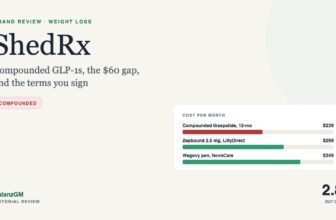
ShedRx review — what one telehealth service charges for each molecule, and what the twelve-month tier actually commits you to.
bmiMD review — the same two molecules sold compounded, at $99 and $139 a month prepaid.