

Weight loss › Who qualifies
BalanzGM is reader-supported — we may earn a commission from links on this site, at no extra cost to you. See our affiliate disclosure. This article is information, not medical advice.
The short version. Two things decide eligibility. The first is a threshold — a BMI at or above 30, or at or above 27 with a weight-related health problem. The second is a set of exclusions, and those matter more than most people expect. No online quiz can settle either. A clinician decides, and no legitimate service will promise you a prescription before one has looked.
The threshold
The NIDDK states the criteria for prescription weight-management medication as “a BMI of 30 or greater” or “a BMI of 27 or greater, and you have weight-related health problems.”
The Zepbound label frames its indication the same way: obesity at a BMI of 30 kg/m² or above, or overweight at a BMI of 27 to under 30 with at least one weight-related comorbid condition. Hypertension, dyslipidaemia and type 2 diabetes are the conditions that appear as examples; the labels do not publish a closed list.
For context, the CDC’s adult categories are: healthy weight 18.5 to under 25; overweight 25 to under 30; class 1 obesity 30 to under 35; class 2 obesity 35 to under 40; class 3 obesity 40 or greater.
For adolescents, Wegovy injection is indicated from age 12 with a BMI corresponding to “≥95th percentile for age and sex.” Wegovy tablets and Zepbound are adults only.
The exclusions, which are the part that gets skipped
These are not fine print. They are the reason a real medical intake exists.
Absolute contraindications
Both semaglutide and tirzepatide are contraindicated in patients with “a personal or family history of MTC” — medullary thyroid carcinoma — “or in patients with MEN 2”, Multiple Endocrine Neoplasia syndrome type 2. That language is identical across the Wegovy, Zepbound, Ozempic and Mounjaro labels, and it follows a boxed warning: in animal studies these drugs caused thyroid C-cell tumours at clinically relevant exposures, and “it is unknown whether” they do so in humans.
The other absolute exclusion is a prior serious hypersensitivity reaction to the drug or any of its excipients.
Conditions that require judgement rather than a flat no
The labels’ Warnings and Precautions sections name the histories a clinician has to weigh:
- Pancreatitis. “Acute pancreatitis, including fatal and non-fatal hemorrhagic or necrotizing pancreatitis, has been observed in patients treated with GLP-1 receptor agonists.”
- Gallbladder disease. Cholelithiasis and cholecystitis occur more often than on placebo, and more often in adolescents than adults.
- Severe gastroparesis. Wegovy “is not recommended in patients with severe gastroparesis.”
- Diabetic retinopathy. “Patients with a history of diabetic retinopathy should be monitored for progression.”
- Kidney function. Acute kidney injury can follow dehydration from vomiting or diarrhoea; renal function warrants monitoring where GI effects are significant.
- Insulin or sulfonylureas. These raise hypoglycaemia risk in combination and usually need dose adjustment.
- Upcoming surgery. The labels note “rare postmarketing reports of pulmonary aspiration in patients receiving GLP-1 receptor agonists undergoing elective surgeries.” Tell your anaesthetist.
Pregnancy
Worth stating precisely, because it is often overstated. Pregnancy is not listed in the contraindications section of the Wegovy or Zepbound labels — it is handled under warnings. Wegovy’s instruction is to “discontinue WEGOVY in pregnant patients receiving it for weight reduction” and to “discontinue WEGOVY at least 2 months before a planned pregnancy because of the long half-life of semaglutide.” Zepbound’s is that “weight loss offers no benefit to a pregnant patient and may cause fetal harm”, with advice to stop when a pregnancy is recognised; that label carries no equivalent two-month pre-conception window.
Tirzepatide has a separate instruction for people using oral contraceptives — switch to a non-oral method or add a barrier method for four weeks after starting and after each dose increase.
What a proper intake should ask you
There is no single published screening checklist from NIH or CDC — we looked. What follows is built from the exclusions in the labels themselves, and it is a fair test of whether an intake is doing its job:
- Height, weight and BMI, plus any weight-related conditions.
- Personal or family history of medullary thyroid carcinoma, or MEN 2.
- History of pancreatitis, gallbladder disease or significant gastrointestinal disease.
- Diabetes status, and specifically whether you take insulin or a sulfonylurea.
- Kidney and liver history; diabetic retinopathy.
- Pregnancy, breastfeeding, plans to conceive, and contraception method.
- A full current medication list.
- Prior reactions to GLP-1 medications.
Getting a prescription is not the same as qualifying
Two things worth separating. Whether you meet the clinical criteria is a medical question. Whether a given service will prescribe to you is a commercial and legal one — it depends on the state you live in, what that provider is licensed and willing to dispense, and how their clinicians exercise discretion.
No service can promise the outcome of a medical evaluation, and any that implies it is telling you something it cannot know. Legitimate providers say the opposite in their own terms: clinicians retain full discretion to prescribe or decline.
How the relationship gets established also varies. State law, not federal law, governs what is required before a prescription can be written, and most states do not treat an online questionnaire on its own as sufficient. A number require some form of real-time contact — audio or audio-visual — but the requirement differs by state and by drug class. Check your own state’s medical board rules rather than assuming a national rule exists. GLP-1 medications are not controlled substances, so the DEA telemedicine rules people often cite do not apply to them.
Sources
- NIDDK, “Prescription Medications to Treat Overweight & Obesity”, last reviewed June 2024 — niddk.nih.gov
- NIDDK, “Treatment for Overweight & Obesity”, last reviewed May 2023 — niddk.nih.gov
- CDC, “Adult BMI Categories”, last reviewed 19 March 2024 — cdc.gov
- FDA prescribing information, WEGOVY, rev. 05/2026 — accessdata.fda.gov
- FDA prescribing information, ZEPBOUND, rev. 01/2026 — accessdata.fda.gov
- Center for Connected Health Policy, “State Telehealth Policies for Online Prescribing” — cchpca.org
More in the weight loss hub: side effects by the numbers · compounded vs brand-name
Compounded medications are not FDA-approved and are not generic versions of brand-name drugs. Eligibility and treatment are determined by a US-licensed clinician; results vary.
Medical disclaimer. This article is for general information only and is not medical advice. It is not intended to diagnose, treat, cure or prevent any condition. Prescription treatments require evaluation by a US-licensed clinician, who decides whether treatment is appropriate for you. Talk to your own healthcare provider before starting, stopping or changing any medication. Individual results vary.
Related review
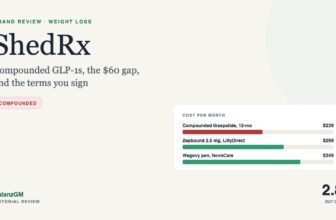
ShedRx review — and the gap between a brand’s “all 50 states” claim and what its own state pages list.
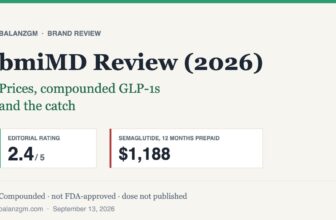
bmiMD review — what a questionnaire-only intake screens for, and what bmiMD will not tell you before you pay.