

Weight loss › Compounded vs brand-name
BalanzGM is reader-supported — we may earn a commission from links on this site, at no extra cost to you. See our affiliate disclosure. This article is information, not medical advice.
The short version. Compounded semaglutide and tirzepatide are not FDA-approved and are not generic versions of the brand-name drugs. The FDA has not reviewed them for safety, effectiveness or quality. For a period they were widely available because the approved products were in shortage; the FDA declared both shortages resolved, in December 2024 and February 2025, and the grace periods that followed have expired. If a service is still offering compounded versions, that is a question to ask before you pay — not after.
Compounded medications are not FDA-approved and are not generic versions of brand-name drugs. Eligibility and treatment are determined by a US-licensed clinician; results vary.
What compounding is
Compounding is the preparation of a medication by a pharmacist for an individual patient — historically for real clinical needs, such as a patient who cannot tolerate a dye in the commercial product, or who needs a strength that is not manufactured.
Two sections of federal law govern it. Section 503A covers state-licensed pharmacies and physicians compounding for individually identified patients pursuant to a prescription. Section 503B covers registered outsourcing facilities, which can compound at larger scale but face tighter restrictions on which bulk substances they may use.
Neither route produces an FDA-approved drug. The FDA’s own wording:
— FDA, “FDA clarifies policies for compounders as national GLP-1 supply begins to stabilize”, 1 April 2026
And more explicitly on what that means in practice: “Compounded drugs are not FDA approved. This means the agency does not review compounded drugs for safety, effectiveness or quality before they are marketed.”
Not a generic — the distinction that gets blurred
A generic drug is a different thing entirely. It is approved by the FDA after the sponsor demonstrates the same active ingredient, strength, dosage form, route and bioequivalence to the reference product. There is no approved generic semaglutide or tirzepatide in the United States.
A compounded preparation is not a generic, has not been shown bioequivalent to anything, and has not been evaluated by the FDA. Marketing that describes a compounded product as a “generic” version of a brand-name drug, or that leans on the brand name to imply equivalence, is exactly the practice the FDA has been issuing warning letters over.
What changed, and when
Compounders were permitted to make copies of these drugs while the approved products were on the FDA’s shortage list. That permission ended when the shortages did.
| Drug | Shortage declared resolved | 503A enforcement deadline | 503B enforcement deadline |
|---|---|---|---|
| Tirzepatide | 19 December 2024 | 18 February 2025 | 19 March 2025 |
| Semaglutide injection | 21 February 2025 | 22 April 2025 | 22 May 2025 |
The FDA based both determinations on manufacturer supply data showing supply meeting or exceeding national demand. In its own words on tirzepatide, “the tirzepatide injection product shortage is resolved”; on semaglutide, “FDA has determined the shortage of semaglutide injection products… is resolved.”
In April 2026 the agency went a step further and proposed excluding semaglutide, tirzepatide and liraglutide from the 503B bulks list. FDA Commissioner Marty Makary put the principle bluntly: “When FDA-approved drugs are available, outsourcing facilities cannot lawfully compound using bulk drug substances unless there is a clear clinical need.” That is a proposal rather than a final rule — check its status before treating it as settled.
The FDA’s specific safety concerns
These are not hypothetical objections. The agency has published what it has actually seen.
Dosing errors
“FDA received multiple reports of adverse events, some requiring hospitalization, that may be related to dosing errors associated with compounded injectable semaglutide products.” The agency attributes these to patients self-administering incorrect doses and to health professionals miscalculating amounts. Compounded products are often supplied in vials with a syringe rather than in a pre-set pen, and the arithmetic is on the person holding it.
Salt forms — a different active ingredient
“The agency is aware that some semaglutide products sold by compounders may be the salt forms. These salt forms, including semaglutide sodium and semaglutide acetate, are different active ingredients than are used in the approved drugs.”
Read that again. Not a different manufacturer of the same ingredient — a different ingredient.
The reported volume
As of 31 May 2026 the FDA had received 990 reports of adverse events associated with compounded semaglutide and more than 730 associated with compounded tirzepatide. Adverse-event reports are not proof of causation and are known to be under-reported; they are a signal, not a count of harm.
Why compounded products are still everywhere
Price, mostly. Compounded versions are typically a fraction of the cost of the approved products, and for people paying cash without insurance coverage that gap is the whole decision.
That is a real dilemma and we are not going to pretend it away. What we would say is that the trade-off should be made with the actual terms in view: not FDA-approved, not reviewed for safety or effectiveness or quality, possibly a different salt form, and dosing that puts more on you.
It is also worth knowing that many telehealth services present compounded medication as the default option and the brand-name product as a premium tier — or do not offer the brand at all. That framing is a commercial choice, not a clinical one.
What to ask before you pay
- Is this FDA-approved or compounded? Ask for the answer in writing. A provider that will not state it plainly has told you something.
- Which pharmacy compounds it, and is it a 503A pharmacy or a 503B outsourcing facility? Many services never name the pharmacy anywhere on their site.
- Which form of the active ingredient? Semaglutide base, or a salt form.
- How is it supplied — pen or vial and syringe? If it is a vial, who calculates the dose, and what happens if you get it wrong.
- What is the clinical justification? Compounding exists for patients who need something the approved product cannot give them. If nothing about your case requires it, ask why it is being offered.
- What are the billing terms? Renewal interval, notice period for cancellation, and whether a refund is possible once the prescription has gone to the pharmacy.
Sources
- FDA, “FDA clarifies policies for compounders as national GLP-1 supply begins to stabilize”, 1 April 2026 — fda.gov
- FDA, “FDA’s Concerns with Unapproved GLP-1 Drugs Used for Weight Loss”, 15 June 2026 — fda.gov
- FDA Declaratory Order, tirzepatide shortage resolved, 19 December 2024 — fda.gov
- FDA Declaratory Order, semaglutide shortage resolved, 21 February 2025 — fda.gov
- FDA press announcement, proposal to exclude semaglutide, tirzepatide and liraglutide from the 503B bulks list, 30 April 2026 — fda.gov
- FDA, “Compounding when Drugs are on FDA’s Drug Shortages List” — fda.gov
More in the weight loss hub: who qualifies · side effects by the numbers
Medical disclaimer. This article is for general information only and is not medical advice. It is not intended to diagnose, treat, cure or prevent any condition. Prescription treatments require evaluation by a US-licensed clinician, who decides whether treatment is appropriate for you. Talk to your own healthcare provider before starting, stopping or changing any medication. Individual results vary.
Related review
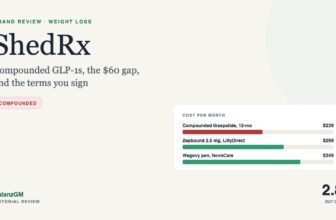
ShedRx review — a live example of the compounded-versus-brand trade: $239 a month against $299 for the FDA-approved drug.
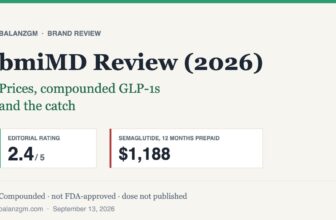
bmiMD review — the cheapest compounded GLP-1 we have priced, and what the saving actually costs.