

Men’s health › Online vs in-person care
BalanzGM is reader-supported — we may earn a commission from links on this site, at no extra cost to you. See our affiliate disclosure. This article is information, not medical advice.
The short version. Telehealth solved a real problem: men avoid these appointments, and the ones who most need care are often the least likely to book it. But the same convenience that removes embarrassment can remove the physical exam, the blood work and the follow-up. Whether that matters depends entirely on which condition you are treating — and the honest answer differs between ED and TRT.
What online care genuinely does better
Two things, and both are real.
It gets people through the door. ED affects between 30 and 50 million American men according to the NIDDK, and the reason so many go untreated is not access to pharmacies. Removing the waiting room removes the barrier.
It is often faster and cheaper. For a healthy man with straightforward ED and no cardiovascular history, an asynchronous review that ends in a PDE5 inhibitor is a reasonable use of everyone’s time.
What it structurally cannot do
A physical examination. AUA Statement 1 asks for “a thorough medical, sexual, and psychosocial history; a physical examination; and selective laboratory testing.” A questionnaire covers the first, partially. It cannot palpate a prostate, check peripheral pulses or examine for Peyronie’s disease.
Blood work, unless it arranges it. AUA Statement 4 asks for morning total testosterone in men with ED. Some online services order labs. Many do not.
Notice what you did not come in for. This is the big one. ED is “a risk marker for underlying cardiovascular disease” in the AUA’s words, and Mayo Clinic notes it often precedes a cardiac event by years. A service optimised to fulfil the request you typed will fulfil it. A clinician looking at a 52-year-old with new ED, a thick neck and a family history is looking at something else.
What the law actually requires
This is widely misreported, so here is what can be supported.
State law governs, not federal law. How a patient-provider relationship must be established before a prescription is written is set by each state’s medical practice rules.
The Center for Connected Health Policy — the federally funded National Telehealth Policy Resource Center — summarises the position: “most states consider using only an internet/online questionnaire to establish a patient-provider relationship (needed to write a prescription in most states) as inadequate.”
Individual examples from that tracker: Alaska provides that clinicians “may not prescribe, dispense, or administer a prescription drug in response to an Internet questionnaire or electronic mail message.” Arkansas provides that a professional relationship “cannot be established only through” internet questionnaires or similar asynchronous methods. Alabama requires synchronous audio or audio-visual communication for controlled substance prescribing — note “audio or audio-visual”, which is not a video mandate.
One clarification that avoids a common error: neither GLP-1 medications nor PDE5 inhibitors nor testosterone gels are federally controlled substances in the way opioids are, so the DEA telemedicine rules frequently cited in this context do not govern them. Testosterone is a Schedule III controlled substance, which does bring additional requirements — a distinction worth keeping straight.
A reasonable way to decide
| Situation | Online is a sensible starting point | See someone in person |
|---|---|---|
| Straightforward ED, healthy, no cardiac history, under 40 | ✓ | |
| New ED over 40, or with hypertension, diabetes, high cholesterol, smoking or family history of heart disease | ✓ — the ED may be the symptom that matters least | |
| ED that began after starting a new medication | ✓ — with whoever prescribed it | |
| Refill of something already working, prescribed after a proper workup | ✓ | |
| Considering TRT | Only if the service does two morning fasting draws, LH, and ongoing monitoring | ✓ in most cases |
| Chest pain, breathlessness or reduced exercise tolerance alongside ED | ✓ — promptly, and not for the ED |
Nine questions to ask any online provider
- Will a licensed clinician review my case, and can I see their name and state licence?
- Is the review asynchronous, or is there a live consultation?
- Does the intake ask about heart disease, blood pressure, diabetes and current medications — including nitrates?
- Will any blood work be ordered, and who pays for it?
- For TRT: how many testosterone measurements before a prescription, at what time of day, and will LH be measured?
- For TRT: what is the monitoring schedule for haematocrit and PSA, and how are those drawn?
- Is the medication FDA-approved or compounded, and which pharmacy dispenses it?
- How do I reach a clinician if something goes wrong at 11pm?
- What are the billing terms — renewal interval, notice period, and refunds after the prescription is issued?
A provider that answers all nine plainly on its own website is telling you something good about itself. So is one that does not.
Sources
- Center for Connected Health Policy, “State Telehealth Policies for Online Prescribing” — cchpca.org
- Federation of State Medical Boards, “Telemedicine Policies: Board-by-Board Overview”, September 2024 — fsmb.org
- HHS, Telehealth policy — telehealth.hhs.gov
- American Urological Association, “Erectile Dysfunction: AUA Guideline” — auanet.org
- Bhasin S, et al., Endocrine Society Clinical Practice Guideline, J Clin Endocrinol Metab 2018 — academic.oup.com
- NIDDK, “Definition & Facts for Erectile Dysfunction” — niddk.nih.gov
- Mayo Clinic, “Erectile dysfunction: A vital sign for cardiovascular health”, 26 June 2025 — mayoclinic.org
More in the men’s health hub: what TRT is · sildenafil vs tadalafil
Compounded medications are not FDA-approved and are not generic versions of brand-name drugs. Eligibility and treatment are determined by a US-licensed clinician; results vary.
Medical disclaimer. This article is for general information only and is not medical advice. It is not intended to diagnose, treat, cure or prevent any condition. Prescription treatments require evaluation by a US-licensed clinician, who decides whether treatment is appropriate for you. Talk to your own healthcare provider before starting, stopping or changing any medication. Individual results vary.
Related review
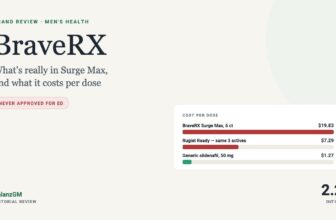
BraveRX review — a worked example of what an asynchronous questionnaire does and does not tell you about a prescriber.