
BalanzGM is reader-supported. Some links on this page are affiliate links — if you buy through them we may earn a commission at no extra cost to you. It never changes what the evidence section says. See our affiliate disclosure.
This article summarizes published evidence — two randomized controlled trials, FDA-approved drug labeling for both the topical and the oral form, and a 1,404-patient safety study, each cited below. It is written by journalists, not clinicians, and has not been reviewed by a physician. Talk to a doctor or a board-certified dermatologist before starting or stopping any treatment. Full medical disclaimer.
What the status labels on this page mean
- FDA-approved
- The FDA reviewed the evidence and approved this drug for pattern hair loss.
- Off-label
- An FDA-approved drug being prescribed for something other than what it was approved for. Legal and common, but the hair loss use has not been through FDA review.
What this page found
- Foam and liquid are the same drug at the same strength. No trial shows one grows more hair than the other. The liquid contains propylene glycol; the foam does not, which is why foam is the switch for an itchy scalp.
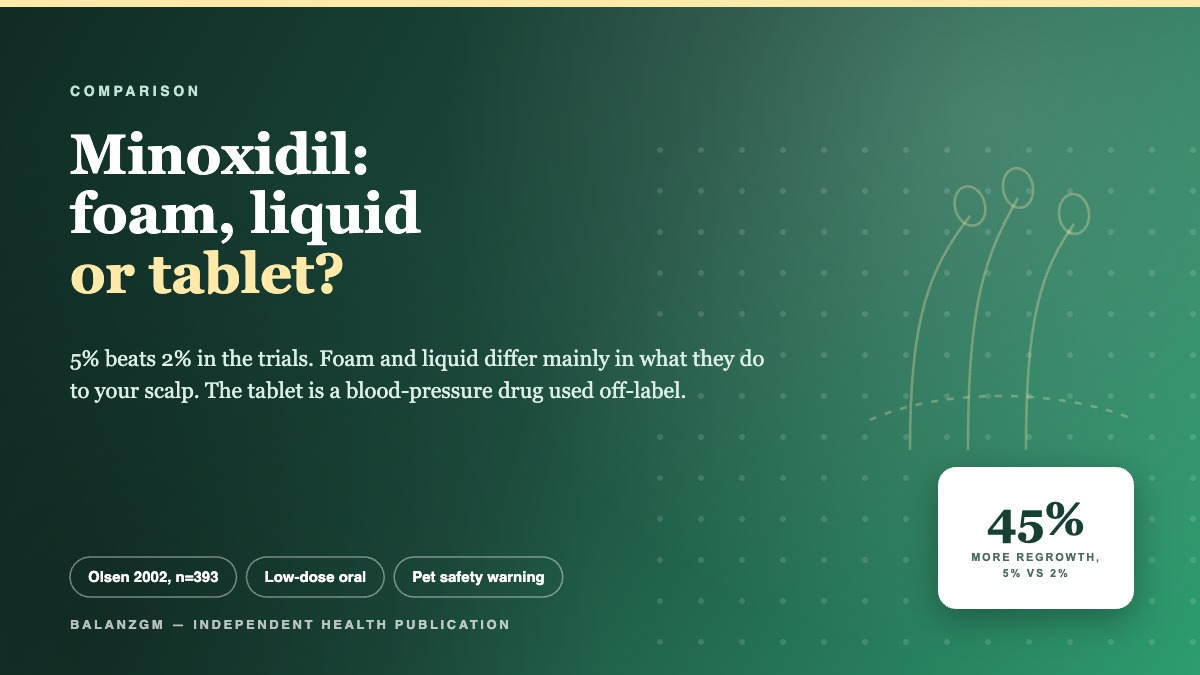
- 5% beats 2% in men — 45% more regrowth at week 48 in a 393-man randomized trial — but with more itching and irritation.[1]
- In women, a 381-woman trial found 5% superior to 2% on patient self-assessment, with more itching, irritation and unwanted facial hair.[2]
- The oral tablet is a different regulatory animal: FDA-approved only for resistant hypertension, with a boxed warning about pericardial effusion. Hair use is entirely off-label.[4]
- The largest low-dose oral safety series — 1,404 patients — reported zero severe adverse events, unwanted body hair in 15.1%, and 1.7% discontinuation.[5]
- Topical minoxidil is toxic to cats. In a 211-case veterinary series, 8 of 62 exposed cats died.[8]
Foam versus liquid is the smallest of the three questions
Most of the internet treats this as the main decision. It is not. Minoxidil topical foam FDA-approved and minoxidil topical solution FDA-approved are the same active ingredient, at the same 5% strength, both approved by the FDA for sale over the counter. There is no head-to-head randomized trial establishing that either one regrows more hair than the other, and we would be inventing a finding if we told you there was.
What differs is the vehicle — what the drug is dissolved in. The solution uses propylene glycol as a carrier. That is the ingredient most commonly implicated in the scalp itching and contact irritation people report. The foam does not contain it. So the real rule is simple:
| Situation | Reasonable choice |
|---|---|
| Your scalp itches, flakes or stings on the liquid | Switch to the foam. Same drug, no propylene glycol. |
| You have long hair and the liquid runs or looks greasy | Foam. It is a handling preference, not a clinical one. |
| The liquid works and does not bother you | Stay on it. There is no efficacy reason to pay more for foam. |
| You want the cheapest FDA-approved option | Generic 5% solution. It is the same molecule as the branded foam. |
Anyone telling you the foam is clinically superior is selling you a vehicle.
2% versus 5%: this one does have trial data
What the trial found
Olsen EA, Dunlap FE, Funicella T, et al. Journal of the American Academy of Dermatology, 2002
- Design
- Randomized, placebo-controlled trial, 48 weeks
- Participants
- 393 men aged 18-49 — 5% (n=157), 2% (n=158), placebo (n=78)
- Main result
- 5% minoxidil was significantly superior to both 2% and placebo on change in nonvellus hair count. At week 48 the 5% group showed 45% more hair regrowth than the 2% group, and responded earlier.[1]
Stated limitation: Pruritus and local irritation were more common in the 5% group. The abstract does not publish the absolute hair counts for each arm, so we cannot show you the raw numbers behind the 45% figure.
Source: published randomized controlled trial[1].
What the trial found
Lucky AW, Piacquadio DJ, Ditre CM, et al. Journal of the American Academy of Dermatology, 2004
- Design
- Randomized, placebo-controlled trial, 48 weeks
- Participants
- 381 women aged 18-49 — 5% (n=153), 2% (n=154), placebo (n=74)
- Main result
- The 5% group was significantly superior to 2% on patient self-assessment at week 48.[2]
Stated limitation: Itching, local irritation and hypertrichosis — unwanted hair growth, including on the face — were all higher in the 5% group. As with the men’s trial, absolute hair count figures per arm are not in the abstract.
Source: published randomized controlled trial[2].
The pattern in both trials is the same: the stronger concentration works better and irritates more. That is a trade, not a free upgrade. For women in particular, the facial hair signal in the 5% arm is the reason the approved women’s product is dosed as half a capful once daily rather than the twice-daily men’s regimen.[3]
The oral tablet is not a stronger version of the topical
This is where the three options stop being variations on a theme. Minoxidil tablets Off-label are FDA-approved for one thing: symptomatic hypertension or hypertension associated with target organ damage that is not manageable with a maximum therapeutic dose of a diuretic plus two other antihypertensive agents.[4] Hair loss is nowhere in that indication. Every prescription of oral minoxidil for hair is off-label.
Off-label prescribing is legal and routine. But it means the FDA has never evaluated this drug for this purpose, at this dose, in this population — and it means the label you can read online was not written about you.
How to read the boxed warning without panicking
The Loniten label carries a boxed warning stating that minoxidil can cause pericardial effusion, occasionally progressing to tamponade, and can exacerbate angina pectoris, and that it should be administered under close supervision, usually with a beta blocker to control tachycardia and a diuretic to control fluid retention. Pericardial effusion occurred in about 3% of non-dialysis patients, and hypertrichosis in about 80%, appearing after three to six weeks.[4]
The dose gap that most articles skip
That warning describes the approved antihypertensive dose range: 10 to 40 mg per day, up to 100 mg.[4] Low-dose oral minoxidil for hair is typically 0.5 to 2.5 mg per day in women and 2.5 to 5 mg per day in men.[6]
That is a difference of roughly four- to eightyfold at the low end. It would be dishonest to present the boxed warning as if it applied unchanged at 1 mg. It would be equally dishonest to pretend a boxed warning about fluid around the heart is irrelevant to the same molecule. Both things are true: the dose is far lower, and the drug is the same one that warning was written about.
The review that documents the low-dose regimens describes cardiovascular adverse events such as tachycardia and dizziness at under 5%, and pericardial effusion as extremely rare and usually linked to compounding errors. Its authors state plainly that low-dose oral minoxidil remains an off-label treatment.[6]
Sources: FDA-approved labeling for minoxidil tablets[4] and a 2025 narrative review[6].
The largest safety data set, and what it can and cannot tell you
What the trial found
Vañó-Galván S, et al. Journal of the American Academy of Dermatology, 2021
- Design
- Multicenter retrospective safety study
- Participants
- 1,404 patients — 943 women (67.2%) and 461 men (32.8%), mean age 43
- Main result
- Hypertrichosis 15.1%, lightheadedness 1.7%, fluid retention 1.3%, tachycardia 0.9%, headache 0.4%, periorbital edema 0.3%, insomnia 0.2%. No severe adverse events. Total discontinuation 1.7%.[5]
Stated limitation: This is a retrospective multicenter series, not a randomized controlled trial. It records what happened to patients who were prescribed the drug and stayed in follow-up; it cannot tell you what would have happened to a matched group who took nothing, and it does not capture people who left care.
Source: published multicenter safety study[5].
Reported adverse effects, low-dose oral minoxidil (n=1,404)
Off-label
A separate review of 17 studies covering 634 patients concluded that oral minoxidil was effective and well tolerated in healthy patients struggling with the topical form — while its own authors called for larger randomized studies comparing different doses with standardized objective measurement.[7] When the people making the case for a treatment say the evidence base needs to be bigger, that is worth repeating rather than smoothing over.
Shedding, and how long any of this takes
The FDA-approved label for the 5% women’s product states that results may be seen at three months with once-daily use, and that some women may need at least six months.[3] It also states that if you stop, normal hair loss will start again and you will likely lose the newly grown hair within three to four months.[3] There is no version of this drug that you take for a season and then finish.
Early shedding after starting minoxidil is widely described and is consistent with the published mechanism — the drug shortens the resting phase and pushes follicles into growth, which releases the old hair. But the FDA label does not describe a distinct shedding phenomenon, and we could not access the full text of the 2024 JAAD International paper on shedding at oral minoxidil initiation. So we are not going to give you a percentage or a week-count for it. If a page gives you one without a citation, it made it up.
If you have a cat, read this paragraph
What the three forms cost over a year
| Route | Typical 12-month cost | Status |
|---|---|---|
| Generic topical 5% solution or foam, retail | Varies by retailer — see note below | FDA-approved |
| Ro topical minoxidil, 12-month plan | $156[10] | FDA-approved |
| Oral minoxidil 2.5 mg generic + GoodRx | from about $142 ($11.86/month)[9] | Off-label |
| Keeps oral minoxidil | $330 plus $20 shipping = $350[11] | Off-label |
| Ro oral minoxidil, 12-month plan | $288[10] | Off-label |
We could not independently verify current US retail prices for Rogaine or Kirkland Signature topical minoxidil. Costco returned an access error, Amazon blocks automated retrieval, and the major pharmacy chains render prices in JavaScript that our tooling cannot read. The only source with figures was a blog published by a company that sells a competing product, which we do not consider adequate. Check the price yourself at the retailer rather than trusting a number on a page like this one.
Choosing between the three
Reasons the topical is the right starting point
- You want an FDA-approved option you can buy without a prescription
- You have not tried topical minoxidil consistently for at least four to six months
- You are comfortable applying something daily and remembering it
- You want the option with the smallest systemic exposure
Reasons to go oral that do not hold up
- You want the oral tablet because it seems more serious or more powerful
- You are choosing oral to skip the daily application without a prescriber involved
- You are buying minoxidil tablets from a source that does not require a prescription
- You have a heart condition and have not raised it with a clinician
The honest summary: start topical, because it is the approved route with the smallest systemic footprint and the lowest cost. Move to the foam if the liquid irritates you. Consider the oral tablet only as a conversation with a prescriber who knows your cardiovascular history — not as an upgrade you select yourself.
Oral minoxidil needs a prescriber, not a checkout page
The topical forms are available over the counter. The tablet is not, and the reason is on its label. Sesame Care is a US marketplace that lists consultation prices upfront in cash, including hair loss visits, so you can see what the conversation costs before you book it.
Sesame Care is a US telehealth marketplace that lists upfront cash prices for appointments. The link below is an affiliate link: if you book, we may earn a commission at no extra cost to you.
See hair loss consultation prices →Where to go next
Frequently asked questions
Is minoxidil foam better than liquid?
Neither has been shown to grow more hair than the other. They deliver the same active drug at the same 5% strength, and both are FDA-approved over the counter. The difference is the vehicle: the liquid solution contains propylene glycol, which is the ingredient most often blamed for scalp itching and irritation, and the foam does not. If the liquid irritates your scalp, the foam is the reasonable switch. If it does not, there is no evidence-based reason to pay more for foam.
Is 5% minoxidil better than 2%?
In men, yes. A 393-man randomized trial found 5% produced 45% more hair regrowth than 2% at week 48, with responses appearing earlier – but also with more scalp itching and irritation in the 5% group. In women, a 381-woman trial found 5% superior to 2% on patient self-assessment at week 48, again with more itching, local irritation and unwanted facial hair growth.
Is oral minoxidil safe for hair loss?
Oral minoxidil is not FDA-approved for hair loss at any dose – the tablet is approved only for resistant high blood pressure, and its label carries a boxed warning about pericardial effusion. Hair loss use is off-label at much lower doses. The largest safety study, covering 1,404 patients, reported no severe adverse events, with unwanted body hair in 15.1% and dizziness in 1.7%. That is reassuring but it is not a randomized trial, and it does not remove the need for a prescriber who knows your cardiovascular history.
Does minoxidil make you shed at first?
Increased shedding in the first weeks is widely reported and is consistent with how the drug is understood to work – it pushes resting follicles into a growth phase, and the old hair is released as the new one comes through. We could not find a randomized trial that quantifies how often this happens or how long it lasts, so treat any specific percentage you see online as unsourced.
What happens if I stop minoxidil?
The FDA-approved label for Women’s Rogaine 5% states that if you stop using it, normal hair loss will restart and you are likely to lose the newly grown hair within three to four months. The same logic applies to men’s products and to the oral form: minoxidil suppresses the process, it does not cure it.
Sources
- Olsen EA, Dunlap FE, Funicella T, et al. A randomized clinical trial of 5% topical minoxidil versus 2% topical minoxidil and placebo in the treatment of androgenetic alopecia in men. J Am Acad Dermatol. 2002;47(3):377-385. PMID 12196747.
- Lucky AW, Piacquadio DJ, Ditre CM, et al. A randomized, placebo-controlled trial of 5% and 2% topical minoxidil solutions in the treatment of female pattern hair loss. J Am Acad Dermatol. 2004;50(4):541-553. PMID 15034503.
- U.S. Food and Drug Administration. Women’s ROGAINE 5% Minoxidil Topical Aerosol, Drug Facts label. 2019. accessdata.fda.gov
- U.S. Food and Drug Administration. LONITEN (minoxidil) tablets, prescribing information. 2015. accessdata.fda.gov
- Vañó-Galván S, et al. Safety of low-dose oral minoxidil for hair loss: a multicenter study of 1404 patients. J Am Acad Dermatol. 2021;84(6):1644-1651. PMID 33639244.
- Jimenez-Cauhe J, Lo Sicco KI, Shapiro J, et al. Characterization and management of adverse events of low-dose oral minoxidil treatment for alopecia: a narrative review. J Clin Med. 2025;14(6):1805. mdpi.com
- Randolph M, Tosti A. Oral minoxidil treatment for hair loss: a review of efficacy and safety. J Am Acad Dermatol. 2021;84:737-746. PMID 32622136.
- Tater KC, Gwaltney-Brant S, Wismer T. Topical minoxidil exposures and toxicoses in dogs and cats: 211 cases (2001-2019). J Am Anim Hosp Assoc. 2021;57(5):225-231. PMID 34370845.
- GoodRx. Minoxidil prices and coupons. goodrx.com (checked 8 September 2026)
- Ro. Pricing. ro.co (checked 8 September 2026)
- Keeps. Low-dose oral minoxidil. buy.keeps.com (checked 8 September 2026)
Affiliate disclosure: this page contains affiliate links. We may earn a commission when you buy through them, at no additional cost to you. Commissions never determine what we cover or what the evidence sections say. Read our full affiliate disclosure.
How we researched this: every figure on this page is sourced to a numbered reference below. For this article those sources are FDA-approved drug labeling for both the topical and oral forms, two randomized controlled trials, a 1,404-patient safety study, a veterinary toxicology series, and each service’s own published pricing. Where a figure could not be verified from a primary source, we say so in the text rather than estimating. Prices were checked on the date shown at the top of this page and change frequently. We do not test products and we do not practice medicine. See our review methodology.