
BalanzGM is reader-supported. Some links on this page are affiliate links — if you buy through them we may earn a commission at no extra cost to you. It never changes what the evidence section says. See our affiliate disclosure.
This article summarizes published evidence — FDA drug labels, FDA safety communications and each brand’s own published pricing, each cited below. It is written by journalists, not clinicians, and has not been reviewed by a physician. Talk to a doctor or a board-certified dermatologist before starting or stopping any treatment. Full medical disclaimer.
What this page found
- The same active ingredient — finasteride — costs about $117 a year as a generic tablet with a pharmacy coupon, and $1,308 a year as a compounded topical gel. That is an 11-fold spread for the same molecule.[1, 9]
- Almost every expensive prescription route here is expensive for one reason: it is compounded. The FDA states plainly that no topical finasteride formulation is FDA-approved, which is why there is no generic version to bring the price down.[14]
- Insurance is close to irrelevant. GoodRx notes finasteride is covered for prostate enlargement but not for hair loss — so a discount coupon usually beats a claim.[1]
- The advertised monthly price is not the annual price. $5-per-shipment fees, $40 transfer fees, $20 consult fees and 20% shipping-and-handling deductions are all in published terms, and none of them appear on a pricing page.[4, 8, 9, 13]
- Two things we could not price are named rather than estimated: Happy Head, which blocks its pages from being read, and over-the-counter Rogaine and Kirkland minoxidil, which no retailer we checked publishes in a machine-readable form.
What the status labels on this page mean
- FDA-approved
- The FDA reviewed the evidence and approved this drug for pattern hair loss.
- FDA-cleared
- Allowed on the market through the 510(k) route because it is judged similar to a device already sold — not the same as the FDA independently approving its effectiveness.
- Off-label
- An FDA-approved drug being prescribed for something other than what it was approved for. Legal and common, but the hair loss use has not been through FDA review.
- Compounded
- Mixed to order by a pharmacy. Not FDA-approved, and not reviewed by the FDA for safety, effectiveness or quality.
- Supplement
- A dietary supplement. The FDA does not approve supplements before they go on sale, and claims about them are not FDA-evaluated.
The same drug, an 11-fold price spread
Most writing about the cost of treating hair loss compares services — Hims against Keeps against Ro — when the thing that actually sets your bill is which form of the drug you end up on, and whether that form is one the FDA has approved.
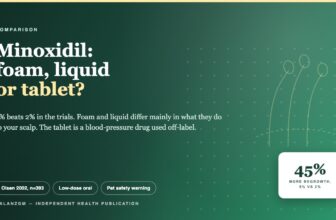
Only two drugs are FDA-approved for pattern hair loss: oral finasteride FDA-approved[15] and topical minoxidil FDA-approved[17, 18]. Both have been generic for years. Everything else on the market is one of those same molecules delivered a more expensive way, a drug approved for something else being used off-label, a device cleared under a different legal standard, or a supplement.
That distinction is the whole cost story. Here are the two ends of it:
| Cheapest published route | ~$117 / year — generic finasteride tablets at GoodRx’s lowest listed price of $9.75[1] |
| Most expensive published route | $1,308 / year — XYON topical finasteride gel at $109/month[9] |
| Same active ingredient? | Yes. Finasteride in both cases. |
| FDA status | Tablets: FDA-approved Topical gel: Compounded[14] |
GoodRx lists $9.75 as the lowest price for “the most common form” of finasteride but does not state on that page whether that is a 30-day or a 90-day supply.[1] We have annualized it as 30 days, which is the conservative reading — if it is a 90-day supply the real annual cost is lower and the gap is wider. We have not found a primary source that settles it, so treat $117 as an upper bound on the cheapest route rather than an exact figure.
What a year costs, by route
Twelve-month cost of treatment, published prices, September 2026
FDA-approved drug Compounded Off-label Supplement Mixed / not disclosed
The cheapest route, and its real catch
Generic oral finasteride with a pharmacy discount card is the cheapest published way to take the better-established of the two approved drugs. GoodRx lists a lowest price of $9.75 against an average retail price of $52.12 without a coupon — a spread of about 81% at the same pharmacy counter.[1] Several named pharmacies sit between $10.50 and $13.80, and GoodRx lists some grocery-chain pharmacies at $0.00 for members of its Companion program.[1]
The catch is not the price, it is what the price excludes. You still need a prescription, a prescriber, and someone to look at your scalp. That is exactly what the telehealth brands sell, so a $192-a-year Ro plan[3] is not being compared like-for-like with $117 of tablets — one includes the consultation and the other does not. The honest way to read the gap is that the convenience layer costs roughly $75 a year.
If the prescription is the part you are stuck on
The $117 route needs a prescriber, and that is the piece a subscription is really selling you. Sesame Care is a marketplace that lists what a consultation costs upfront, in cash, before you book — including hair loss visits. It is one way to price the consultation separately from the medication, so you can see which half of a bundled plan you are actually paying for.
Sesame Care is a US telehealth marketplace that lists upfront cash prices for appointments. The link below is an affiliate link: if you book, we may earn a commission at no extra cost to you.
See hair loss consultation prices →The insurance point most articles get wrong
GoodRx states that generic finasteride is covered by most insurance plans and Medicare for benign prostatic hyperplasia — the prostate indication — but not for hair loss.[1] Most US plans treat hair loss as cosmetic.
The practical consequence is that for a hair loss prescription, a discount coupon is often cheaper than using your insurance. It is worth asking the pharmacy to price both.
We wanted to include over-the-counter Rogaine and Kirkland minoxidil, which is where a lot of people actually start. We could not verify retail pricing from a primary source: the major retailers either block automated access or render prices in a way we could not read. The only figures we found came from a competitor’s blog, which we are not going to treat as a neutral source on a rival’s price. Rather than publish a number we cannot stand behind, we are leaving it out and saying so.
Telehealth pricing, decoded
Every service in this category advertises a “from” price. Those numbers are real, but they describe the cheapest product on the longest prepaid commitment, which is rarely where people land. Here is what each one publishes, converted to a full year.
| Service & product | 12-month cost | Advertised as | Billing | FDA status |
|---|---|---|---|---|
| Ro — finasteride | $192 (12-mo) · $216 (6-mo) · $240 (quarterly) | $16–$20/mo | Quarterly minimum | FDA-approved[3] |
| Ro — topical minoxidil | $156 (12-mo) · $192 (quarterly) | $13–$16/mo | Quarterly minimum | FDA-approved[3] |
| Ro — oral minoxidil | $288 (12-mo) · $360 (quarterly) | $24–$30/mo | Quarterly minimum | Off-label[3] |
| Ro — Mane Spray (fin + min) | $516 (6-mo) · $600 (quarterly) | $43–$50/mo | Quarterly minimum | Compounded[3] |
| Hims — Hair Power Pack | $264 prepaid · $312 quarterly | $22/mo | 3-month minimum | FDA-approved[6] |
| Hims — topical fin + min spray | ~$420 | from $35/mo | Not stated on page | Compounded[7] |
| Keeps — base plan | ~$140 incl. shipping | from $10/mo | Quarterly + $5/shipment | Depends on product[4] |
| Keeps — oral minoxidil | $350 incl. shipping | $20/mo for 3 months | Rises to $30/mo after | Off-label[5] |
| Strut Health — Hairfect Rx topical | ~$708 | from $59/mo | Monthly, cancel anytime | Compounded[8] |
| XYON — oral finasteride | $420 (subscription) | $105 / 90 days | 90-day | FDA-approved[9] |
| XYON — topical finasteride gel | $1,308 | $109/mo | Monthly, cancel anytime | Compounded[9] |
| Happy Head | Not published in a readable form | — | — | Compounded topicals |
Two things stand out once everything is annualized. First, Keeps really is the cheapest annual number at roughly $140 including shipping — but it is also the only service here that will not show you which product you are buying until you complete a quiz, which makes that figure hard to act on.[4] Second, the moment a product becomes a compounded topical, the annual cost roughly triples.
The oral minoxidil rows deserve their own note, because the markup there is the steepest on the table. Ro charges $288 a year for it and Keeps $350.[3, 5] Minoxidil tablets are an old generic blood-pressure drug, and GoodRx lists the 2.5 mg tablets from $11.86, with some pharmacies at no cost for program members.[2] As with finasteride, what the subscription buys you is the prescription and the monitoring, not the molecule — and using minoxidil tablets for hair is Off-label everywhere in the US.
Why the compounded products cost what they cost. On 22 April 2025 the FDA published a safety alert stating that no topical finasteride formulation is FDA-approved, and that compounded topical finasteride products do not carry FDA-approved labeling.[14] That is not a paperwork technicality — it is why there is no generic. Every topical finasteride sold in the US is mixed to order by a compounding pharmacy, in small batches, per prescription, and you are paying for that. The same alert describes 32 adverse event reports received between 2019 and 2024; we cover what those reports say in our oral versus topical finasteride guide.
The fees that are not on the pricing page
All of these appear in published terms. None appear in the advertised monthly figure.
| Service | Cost that is not in the headline price | What it adds over twelve months |
|---|---|---|
| Keeps | $5 per shipment on a plan advertised from $10/month.[4] | $20 — four quarterly shipments × $5 (our calculation) |
| Strut Health | $40 fee to transfer your prescription to a pharmacy outside their preferred network.[8] | $40, once, and only if you leave |
| XYON | $20 consultation fee on one-time orders. Waived on subscription — which is rather the point of it.[9] | $20 on the first one-time order; $0 on subscription |
| Hims | Refunds on the first 90-day finasteride supply must be requested between day 90 and day 180 after delivery. You cannot request one earlier.[6] | $0 in cash — but you cannot get money back in months one or two |
| HairMax | The six-month money-back guarantee deducts 20% shipping and handling.[13] | ~$360 on a $1,799 cap, if you return it — 20% of $1,799 (our calculation) |
| Kiierr | Full refund, but you must have used the device for 210 days and return it between day 210 and day 240.[12] | $0, but you cannot test it and send it back inside seven months |
| Nutrafol | The “Real Growth Guarantee” requires buying six bottles on subscription within 180 days and meeting in-app engagement requirements.[10] | $0, but the guarantee only exists if you have already spent about half a year |
Figures marked our calculation are arithmetic we did on the cited numbers, not figures printed by the company. Everything else in this table is quoted from the company’s own published terms.
Devices: one payment, and a different legal standard
Laser caps are the only category here that is a purchase rather than a subscription, which changes the arithmetic completely over a multi-year horizon.
| Device | Price | Refund terms | Diodes / LEDs |
|---|---|---|---|
| iRestore Essential | $499 (list $799) | 12-month guarantee | 120[11] |
| iRestore Professional | $799 (list $1,499) | 12-month guarantee | 282[11] |
| HairMax LaserBand 82 | $849 | 6 months, minus 20% shipping and handling | 82[13] |
| Kiierr 272 Premier | $1,199 (list $1,799) | Full refund, but only after 210 days of use | 272[12] |
| iRestore Elite | $1,799 (list $2,699) | 12-month guarantee | 500[11] |
| HairMax PowerFlex 272 | $1,799 | 6 months, minus 20% shipping and handling | 272[13] |
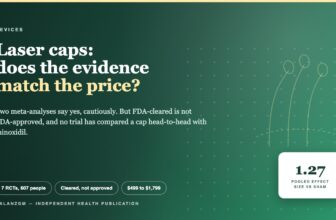
All of these are FDA-cleared rather than FDA-approved, and the difference is substantive. The FDA explains that a 510(k) clearance establishes that a device is substantially equivalent to one already on the market. In the FDA’s own words, the 510(k) review standard is comparative, while the stricter premarket approval standard relies on independent demonstration of safety and effectiveness.[16] Premarket approval, or PMA, is the route FDA-approved drugs go through. A cleared device has not cleared that bar. What the trial evidence actually shows is a separate question, and we cover it in our laser cap guide.
Supplements: the most expensive category by dose
Nutrafol Supplement lists at $88 a month, falling to $70.40 on monthly subscription and to an effective $66 a month if you prepay three or six months. A year runs $792 to $1,056 depending on how you buy.[10]
That puts a dietary supplement above every FDA-approved drug route on this page. The FDA has no authority to approve supplements before they go on sale, and products in this category must state that their claims have not been FDA-evaluated. Whether the price is justified is an evidence question, not a pricing one.
The number nobody quotes: five years
Pattern hair loss treatment is not a course you complete. The FDA-approved Drug Facts label for Women’s Rogaine 5% states that if you stop using it, normal hair loss starts again and you will likely lose the new hair you have grown within three to four months.[17] So the number that matters is not the monthly price, it is the price of a decision you keep paying for.
| Route | Year 1 | 5 years (our calculation) |
|---|---|---|
| Generic finasteride + coupon (floor) | ~$117 | ~$585 |
| Ro finasteride, 12-month plan (typical telehealth) | $192 | ~$960 |
| iRestore Essential (device, one payment) | $499 | $499 |
| Nutrafol, prepaid (supplement) | $792 | ~$3,960 |
| XYON topical finasteride gel (ceiling) | $1,308 | ~$6,540 |
Over five years the compounded topical route costs about what a used car costs, for a delivery method the FDA has not approved. That is the number worth sitting with before you sign up for a monthly plan.
When paying more actually makes sense
None of the above argues that the cheapest option is the right one. There are good reasons to pay a premium, and there are weak ones.
Reasonable reasons to pay more
- You want the prescribing visit, the follow-up and the refill logistics handled — that is a real service, and roughly $75 a year over the generic route is a fair price for it ($192 minus $117, our calculation)
- You cannot tolerate oral finasteride and a topical is the alternative your prescriber has proposed
- You would rather buy a device once than carry an open-ended subscription
- You value being able to cancel monthly instead of committing to a prepaid year
Weak reasons to pay more
- Assuming the expensive version is the more effective version — nothing on this page supports that
- Believing a topical is inherently safer. The FDA specifically warns that some prescribers have falsely claimed there is no risk of adverse events because a product is applied to the skin[14]
- Buying a prepaid year before you know whether you tolerate the drug, when the refund window may not open until day 90[6]
- Paying supplement prices above drug prices without first checking what the trials behind the supplement actually measured
What to do next
If you are early in this and want a concrete sequence rather than a price list:
- Work out what you are actually treating. Pattern hair loss, stress shedding and other causes are not the same problem and do not respond to the same things. A dermatologist can tell you in one visit; our guide to the Norwood and Ludwig scales covers how the pattern is classified.
- Price the generic route first, because it is the floor. Ask a pharmacy what generic finasteride and over-the-counter minoxidil cost with a discount card, and ask them to compare that with your insurance. That number is your baseline for judging everything else. If you need the consultation too, Sesame Care lists visit prices upfront so you can add it to the baseline rather than have it bundled into a subscription.
- Then decide what the convenience layer is worth to you. If getting a prescription is the obstacle, a telehealth service solves a real problem, and roughly $75 a year is what it costs (our calculation from the two cited prices). If you would end up on a compounded topical, read the FDA safety alert first[14] and go in knowing it is not an approved product.
Where to go next
- How finasteride and minoxidil actually work — what the two approved drugs do, and what their trials measured
- Oral vs topical finasteride — the head-to-head trial, and the FDA safety alert on compounded topicals
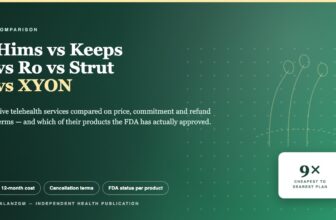
- Hims vs Keeps vs Ro vs Strut vs XYON — the same services compared on more than price
- All our hair loss coverage
Frequently asked questions
Is hair loss treatment covered by insurance?
Generally no. GoodRx notes that generic finasteride is covered by most insurance plans and Medicare when it is prescribed for benign prostatic hyperplasia, but not when it is prescribed for hair loss. Because of that, a pharmacy discount coupon is often cheaper than running the prescription through insurance for a hair loss indication.
What is the cheapest way to treat hair loss?
On published prices, generic oral finasteride bought with a pharmacy discount card is the cheapest prescription route: GoodRx lists a lowest price of $9.75 against an average retail price of $52.12 without a coupon. You still need a prescription, and the price of getting one is not included in that figure.
Why is topical finasteride so much more expensive than the pill?
Because there is no generic. The FDA states that no topical formulation of finasteride is FDA-approved, so every topical finasteride product sold in the US is compounded to order by a pharmacy rather than mass-produced. Compounding is done in small batches per prescription, which costs far more per dose than a generic tablet.
Are laser caps cheaper than medication over time?
They are a single purchase rather than a subscription, so it depends on how long you treat. A $499 iRestore Essential costs less over three years than $59-a-month compounded topical finasteride costs in one. But the two are not interchangeable, and laser devices are FDA-cleared through the 510(k) route rather than FDA-approved on independent evidence of effectiveness.
What hidden fees should I watch for?
The ones in published terms: Keeps charges $5 per shipment; Strut Health lists a $40 fee to transfer a prescription to a non-preferred pharmacy; XYON adds a $20 consultation fee on one-time orders; HairMax deducts 20% shipping and handling from refunds; and Hims only accepts refund requests between day 90 and day 180 after delivery.
Does stopping treatment mean I lose the hair I gained?
For minoxidil, yes, according to the FDA-approved Drug Facts label for Women’s Rogaine 5%: it states that if you stop using it, normal hair loss starts again and you will likely lose the new hair you have grown within three to four months. Treatment for pattern hair loss is generally ongoing rather than a course you finish.
Sources
- GoodRx. Finasteride prices, coupons and savings tips. goodrx.com/finasteride (checked 8 September 2026)
- GoodRx. Minoxidil (oral) prices and coupons. goodrx.com/minoxidil (checked 8 September 2026)
- Ro. Pricing. ro.co/pricing (checked 8 September 2026)
- Keeps. How much does Keeps cost? keeps.com (checked 8 September 2026)
- Keeps. Low-dose oral minoxidil. buy.keeps.com (checked 8 September 2026)
- Hims. Hair Power Pack. hims.com (checked 8 September 2026)
- Hims. Finasteride and Topical Finasteride & Minoxidil Spray. hims.com/hair-loss (checked 8 September 2026)
- Strut Health. Finasteride hair loss formula. struthealth.com (checked 8 September 2026)
- XYON Health. Topical finasteride and oral finasteride. xyonhealth.com (checked 8 September 2026)
- Nutrafol. Nutrafol Men Core. nutrafol.com (checked 8 September 2026)
- iRestore. Device comparison. irestorelaser.com (checked 8 September 2026)
- Kiierr. Kiierr 272 Premier laser cap. kiierr.com (checked 8 September 2026)
- HairMax. PowerFlex 272 Laser Cap and LaserBand 82 ComfortFlex. hairmax.com (checked 8 September 2026)
- U.S. Food and Drug Administration. FDA alerts health care providers, compounders and consumers of potential risks associated with compounded topical finasteride products. 22 April 2025. fda.gov
- U.S. Food and Drug Administration. PROPECIA (finasteride) tablets, prescribing information. 2022. accessdata.fda.gov
- U.S. Food and Drug Administration. Medical device safety and the 510(k) clearance process. fda.gov
- U.S. Food and Drug Administration. Women’s ROGAINE 5% Minoxidil Topical Aerosol, Drug Facts label. 2019. accessdata.fda.gov
- U.S. Food and Drug Administration. Approval letter, NDA 021812/S-009, Women’s ROGAINE 5% Topical Aerosol. 28 February 2014. accessdata.fda.gov
Affiliate disclosure: this page contains affiliate links. We may earn a commission when you buy through them, at no additional cost to you. Commissions never determine what we cover or what the evidence sections say. Read our full affiliate disclosure.
How we researched this: every figure on this page is sourced to a numbered reference below. For this article those sources are FDA drug labels and approval letters, an FDA safety communication, FDA guidance on device clearance, and each brand’s own published pricing pages. Where a figure could not be verified from a primary source, we say so in the text rather than estimating. Prices were checked on the date shown at the top of this page and change frequently. We do not test products and we do not practice medicine. See our review methodology.